



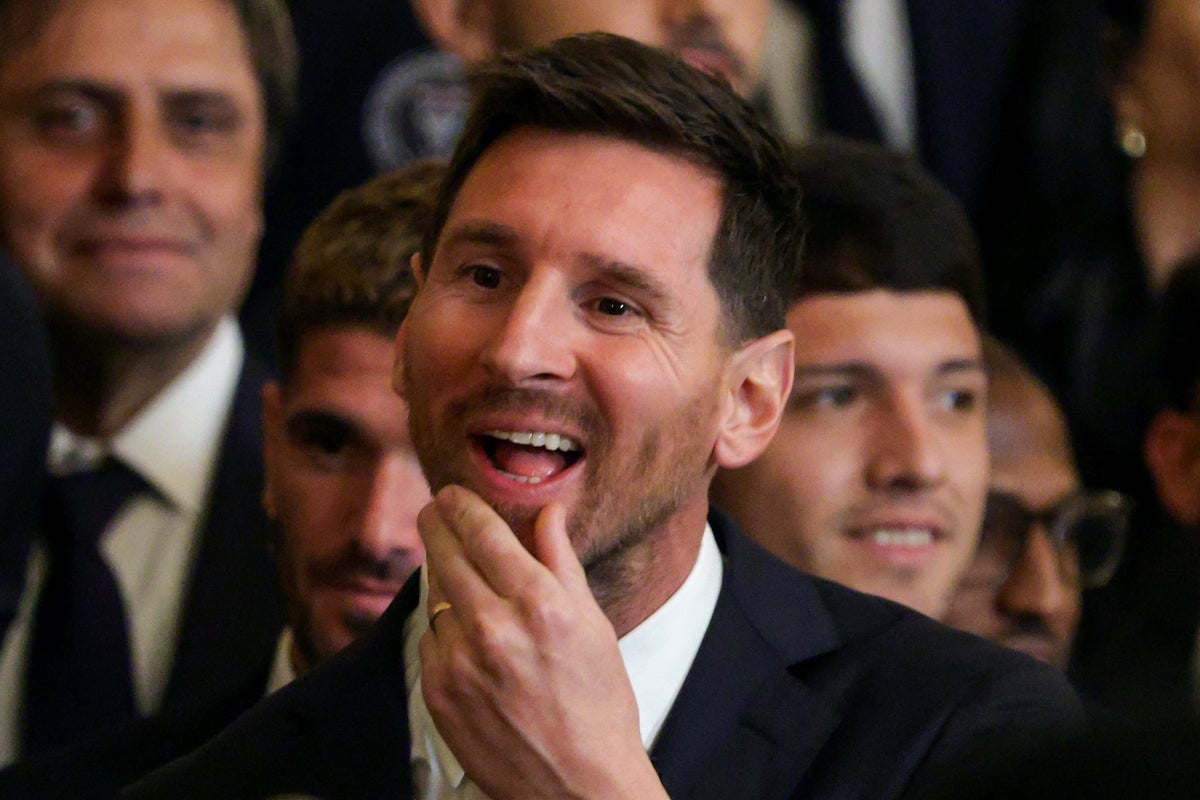
With a shimmering pink soccer ball in hand, Lionel Messi made headlines during his visit to the White House, marking yet another milestone in his illustrious career.
Prior to Thursday, the international soccer icon had skillfully avoided both defenders on the pitch and political leaders, particularly in his home country of Argentina.
There were uncertainties about whether he would join the rest of Inter Miami to celebrate their MLS Cup victory at the White House.
When the team gathered in the room, Messi was not initially among them; instead, he entered alongside U.S. President Donald Trump and team owner Jorge Mas Santos, later presenting Trump with the sparkling soccer ball.
While Messi chose to remain silent throughout the visit, his presence spoke volumes, especially for a player whose political views have largely remained a mystery.

The visit generated surprise and dismay in Argentina, particularly among those who valued the national captain’s political neutrality (Getty Images)
When Argentina triumphed in the 2022 World Cup, the team opted not to visit then-President Alberto Fernández’s Casa Rosada.
Current Argentine President and Trump supporter, Javier Milei, has praised Messi, yet a joint public appearance or photo has not materialized. Last year, Messi was invited by then-U.S. President Joe Biden’s administration to receive the Presidential Medal of Freedom but was unable to attend due to scheduling conflicts.
In light of Messi’s White House visit, many in Argentina were taken aback and felt disheartened, especially those who admired his choice to stay out of politics, a contrast to the politically outspoken Diego Maradona. Nonetheless, some argued that Messi’s presence could benefit Argentina as it prepares for World Cup matches in the U.S.
Kirk Bowman, a professor at Georgia Tech’s Sam Nunn School of International Affairs specializing in soccer and politics in Latin America, expressed little surprise about Messi’s visit.
“He looks at his career long-term, both as a player and a brand. He’s making significant investments, including in Inter Miami itself,” said Bowman.

Despite his silence, Messi’s appearance spoke volumes about a player whose political views remain largely obscured (AP)
“He’s heavily invested in the Miami community, which is quite conservative compared to other soccer regions in the U.S.,” Bowman noted.
Messi stood beside Trump as the president addressed issues concerning Iran, Cuba, and Venezuela, eventually applauding at the end. Some supporters have justified his silence by highlighting his limited English proficiency, a factor that Bowman believes acts as “an additional layer of brand protection.”
Both Inter Miami and Messi’s representatives did not respond to inquiries from The Associated Press regarding the visit. Inter Miami head coach Javier Mascherano commented on it during a press session, saying, “I thought we would discuss football, but that wasn’t the case. We were merely following the tradition for championship teams to visit the White House.”
He reported that the team spent a couple of hours at the White House and that their interactions with Trump were largely as seen on TV, not extending beyond that.
The image of Messi with Trump evoked comparisons to the late Maradona, who had a vocal anti-American stance and openly supported figures like Fidel Castro and Hugo Chávez. Maradona famously featured a tattoo of revolutionary Ernesto “Che” Guevara.
In contrast, Messi has mostly avoided political commentary during his time in various countries, including Argentina, Spain, France, and the U.S. His lengthy tenure at FC Barcelona, from his teenage years until 2021, aligned with a politically charged era in Spain marked by a divisive separatist movement in Catalonia. Throughout this period, Messi carefully maintained his neutral stance on the issue, thus preserving his idol status among Barcelona fans.
While he occasionally celebrated by chanting, “Visca Barça y visca Catalunya!” (“Long live Barça and long live Catalonia!”) — a phrase standard for players — he generally kept his comments devoid of political implications.
Messi’s relationship with Barcelona, as he expressed in a 2024 interview with Catalan television, highlighted his affection for the city and its residents, calling his children “Catalans” and stating, “I feel like I am from Barcelona.”
Glimpses of Messi’s political inclinations appeared in interviews with La Garganta Poderosa, an Argentine leftist magazine, in both 2011 and 2020, where he shared positive reflections on Guevara and described inequality as a pressing societal issue during the pandemic.
However, it is unlikely that Messi will delve deeper into the political realm, according to Bowman.
“I don’t believe he’s comfortable with being political, but he will engage in political contexts as long as it serves his interests positively,” he remarked. Bowman cited Messi’s lucrative contract with Saudi Arabia’s tourism board, amid ongoing “sportswashing” allegations, as a testament to this strategic approach.
“Messi’s involvement follows a similar pattern,” he explained. “He’ll participate in initiatives, provided they do not harm ‘Brand Messi.’”