



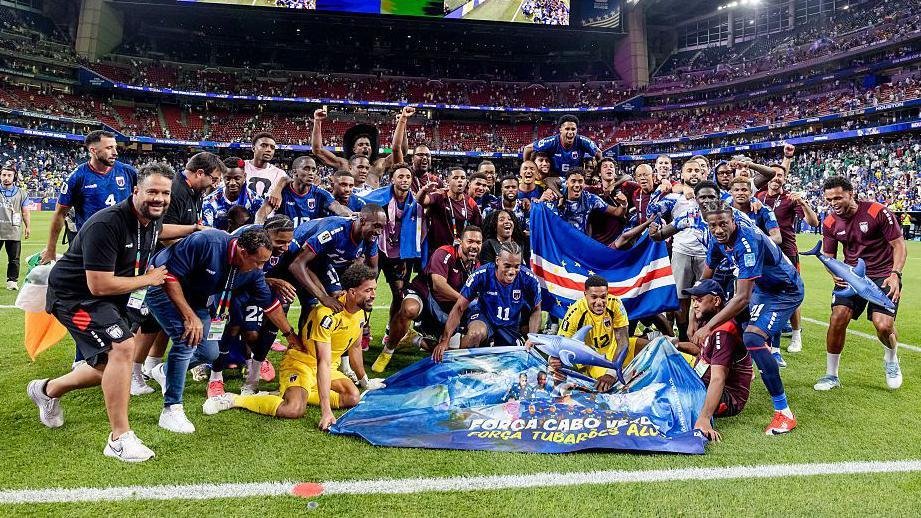
A revamped format, new teams, and intriguing narratives – but did the redesigned group stage of the World Cup truly succeed?
Cape Verde pulled off a remarkable feat by advancing to the last 32, eliminating Uruguay along the way.
Gianni Infantino, FIFA president, likely felt a sense of vindication, as Cape Verde was one of the nations that benefited from the tournament’s expansion to 48 teams.
However, amidst these uplifting tales, the heavyweight teams faced little risk. This was partly due to the decision to allow third-placed teams to progress and FIFA’s choice to use head-to-head results as the primary tiebreaker in the group stage.
The result: Four teams secured their group wins with a game to spare, while five others were knocked out.
With more goals scored than in any tournament since Sweden 1958, can FIFA claim success?
We’d love to hear your thoughts in the comments and see your votes below.
Pros: Fresh Faces, New Stories
The presence of stars like Lionel Messi, Kylian Mbappe, Erling Haaland, Cristiano Ronaldo, and Harry Kane competing in an electrifying race for the Golden Boot generated significant media buzz.
This showcase was advantageous for FIFA, seeing some of the most recognizable players striving for top honors.
However, the World Cup is not solely about individual stars, especially during the group stage; it emphasizes the diversity and culture of global football.
While we avoided significant upsets for major teams, like Saudi Arabia‘s surprising victory over Argentina four years ago, notable stories emerged.
Cape Verde, an island nation in the Atlantic, wasn’t expected to progress to the knockout rounds and had been dismissed by many prior to their departure.
Who could have guessed they’d emerge from a group that included both Uruguay and European champions Spain?
Not only did Cape Verde hold Spain to a scoreless draw, but they also managed a 2-2 tie with Uruguay.
By drawing against Saudi Arabia in their last group match, they secured second place in their group and a matchup against world champions Argentina in Miami.
Although they were the only team in the top two with just three points, they accomplished their goal.
This served as a strong endorsement of Infantino’s initiative, with Cape Verde as a prime example.
Vozinha, their 40-year-old goalkeeper, gained fame as a social media sensation following his heroics against Spain.
Starting with 50,000 followers on Instagram, he skyrocketed to five million by match’s end, and currently has around 16.7 million.
Additionally, his mother, who couldn’t attend the World Cup due to high U.S. visa costs, managed to fly in for the Uruguay match.
This is a unique narrative the World Cup can generate for a player like Vozinha, who has played in Moldova, Cyprus, Slovakia, and the Portuguese second division.

Meanwhile, Curacao, the smallest country ever to qualify, didn’t advance but managed to secure a point against Ecuador.
DR Congo also made headlines with a hard-earned 1-1 tie against Portugal, marking them as one of the strongest third-placed teams.
Haiti‘s Wilson Isidor produced a goal-of-the-tournament candidate against Morocco, further showcasing the expanded format’s potential for memorable stories.
The expansion has opened doors for other narratives as well, with Bosnia-Herzegovina, Canada, Ivory Coast, and South Africa all reaching the knockout rounds for the first time.
However, the increase in teams and generally weaker groups has simplified the pathway to qualification. The first knockouts now resemble the old World Cup format with 32 teams.
Predictably, traditional powerhouses from Europe and South America dominated the tournament. Surprisingly, African nations excelled, with nine out of ten teams advancing to the last 32.
While Cape Verde’s achievement was a point of pride for FIFA regarding the new format, it may overshadow underwhelming performances elsewhere. Does the overall depth justify the expansion?
Despite Concacaf teams gaining 20 points, the majority came from the three co-host nations.
Curacao, Haiti, and Panama, despite benefiting from additional berths, scored only three goals while conceding 21.
Conversely, Asia struggled, with nine teams managing only three victories in 27 matches, averaging just 0.67 points per game. Only Australia and Japan progressed from the group stage.
Given that Asia had their automatic slots doubled, the disparities in performance from other confederations raise questions about the expansion’s merit.
Cons: The Jeopardy is Missing
While captivating stories enhance the tournament, they are just part of the overall experience.
The group stage noticeably lacked excitement for the top nations. Of the twelve top-seeded teams, only co-hosts Canada and Portugal failed to finish atop their groups.
This can be attributed to the expansion to 12 groups, which minimized the likelihood of top teams encountering real threats.
Barring Uruguay’s surprising exit, the ensuing 72 matches felt like a straightforward mechanism to eliminate 16 smaller countries for the next stage.
Yet, the real issue lies in the format. The inclusion of third-placed teams diluted potential risks for the big sides.
Even Ghana coach Carlos Queiroz described the new format as “vulgar and ordinary”, reflecting the sentiment that qualification was too assured.
Additionally, FIFA’s switch from goal difference to head-to-head as the primary tiebreaker removed competitive tension.
Consequently, nine teams were merely completing fixtures in matchday three — four had already secured group victories while five were eliminated.
Had FIFA retained goal difference, the stakes for each team would have remained high.
The absence of genuine competition was palpable, as seen in Ecuador’s notable 2-1 victory over Germany — would it have transpired if Germany had already clinched group victory?
Nonetheless, Ecuador celebrated regardless.
Most matches that drew attention often consisted of one-sided encounters where attack met defense.
In the last World Cup, only five group matches were won by a margin of three or more goals. This time, that number soared to 18.
As a result, this tournament has set records for goals per game, with an average of 2.99, the highest for a group stage since the 32-team format commenced in 1998, with the previous high at 2.83 during the 2014 World Cup.
It’s on track for the highest goals-per-game rate since the 1958 World Cup’s 3.60, yet falls significantly short of the astonishing 5.38 recorded in 1954.

Consider the cases of Scotland and South Korea.
Both nations ended up with three points, yet they had to wait until Saturday evening to learn their fate.
This illustrated the overall unfairness of the third-place standings, heavily favoring teams finishing in the later groups.
Senegal, for example, was aware they needed to score against Iraq to earn a positive goal difference, ultimately coming through with a decisive 5-0 win to secure a berth among the best third-placed teams.
Moreover, the format allowed second and third-placed teams with three points to draw and both qualify for the next round.
The match between Australia and Paraguay had moments of intent, yet it finished 0-0, which surprised few.
Even the thrilling final match between Austria and Algeria ended with both teams aware they were safe with a draw — resulting in a 3-3 scoreline where no side made any noteworthy shots post-68th minute.
Admittedly, it’s impossible for all teams to play simultaneously, yet the disparity in progression based on group draws feels inequitable.
The group stage has resembled more of a warm-up for the main event — almost like a standalone qualifying tournament.
Now that we’re entering the knockout rounds, it’s time for the true World Cup to begin.