



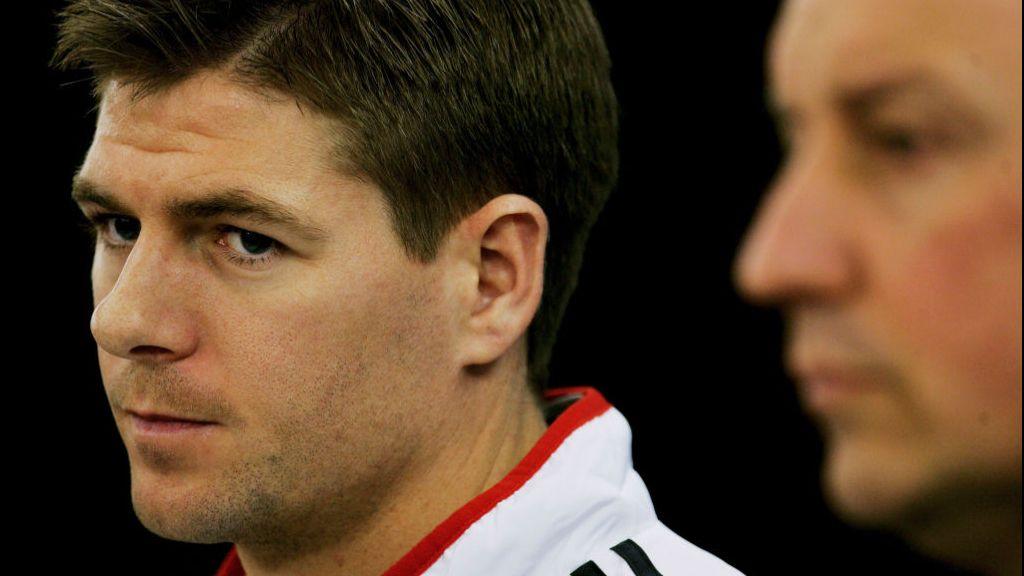
When Steven Gerrard looks back on the 2005 Champions League final, he describes it as the best night of his life. However, just two months later, he revealed he was leaving Liverpool, only to have a change of heart overnight.
In a Netflix documentary reflecting on Liverpool’s triumph in Istanbul, Gerrard admits he was in a “bad place” mentally, likening his thoughts to “a box of frogs.” He noted that criticism from then-manager Rafael Benitez played a role in his wavering commitment to his boyhood club.
In May 2005, Gerrard led Liverpool to one of the most iconic victories in football history, overcoming a 3-0 half-time deficit against AC Milan to win on penalties and secure the club’s fifth European Cup title. Fans hoped this remarkable comeback would persuade him to stay amidst interest from Spanish giants Real Madrid and Premier League champions Chelsea, managed by José Mourinho at the time.
Six weeks after the final, Gerrard announced he was leaving, but then he reconsidered. “Mourinho was on the phone with enticing offers, which would naturally turn your head. Chelsea was spending heavily and guaranteed success,” he said. “I couldn’t separate my feelings for Liverpool. When they came in, I felt torn. Mentally, I was struggling with confusion.” The tension with Benitez only added to his uncertainty. “I felt like he didn’t value or trust me, which made things harder,” Gerrard, now 45, explained.
His former teammate Jamie Carragher remarked that Gerrard “probably needed more support,” a sentiment countered by Carragher’s view of Benitez as emotionless. Throughout the documentary, former players highlight Benitez’s focus on tactical detail, which sometimes felt off-putting.
Gerrard shared, “My game was built on emotion, passion, and desire for the badge. Yet I felt Benitez wanted to reshape me, and nothing seemed to satisfy him.” Benitez, 66, defended his approach, saying that football requires more than just emotion for success.
With time, Gerrard has come to appreciate Benitez’s coaching methods, stating, “Looking back, I consider Rafa the best coach I ever worked with.”
Benitez’s Efforts with Owen

Prior to Gerrard’s transfer saga, Michael Owen’s future had also become a significant topic of discussion. Another product of Liverpool’s academy, Owen became disenchanted with his tenure at Anfield after Gérard Houllier was dismissed as manager in the summer of 2004.
When Benitez took over, one of his first tasks was to persuade his top players to remain at the club. He traveled to Portugal to meet Owen, Gerrard, and Carragher while they were on England duty in the European Championship. However, the approach was not the charm offensive many anticipated.
Gerrard recalled, “He was intense with me about tactics, telling me what I could and couldn’t do. It made me think, ‘You’ll need me more than I need you.'” Carragher later noted that Benitez told Owen, a former Ballon d’Or winner, that he needed to “turn on the ball quicker.” Owen remarked, “That was what I excelled at, and it certainly did not persuade me to stay.”
In August 2004, Owen transferred to Real Madrid for £8 million.
In contrast, Benitez viewed their meeting differently, believing both players appeared content with the conversation.
Benitez’s Unique Training Style
Reflecting on Benitez’s management, Carragher shared that the manager’s training methods were often “a bit weird.” “There were times when we’d practice without a ball, just with cones marking out positions,” he mentioned.
Benitez acknowledged his penchant for detail in coaching, stating, “I like to analyze everything; sometimes it’s the small details that make the difference between success and failure.” This meticulous approach proved beneficial during the penalty shootout in Istanbul, as goalkeeper Jerzy Dudek noted that Benitez had studied Milan’s players’ tendencies carefully.
Dudek explained, “We had a system where the goal was divided into sections, and Rafa gave us insights on where players typically aimed.” He ended up saving two penalties, including the decisive shot from Andriy Shevchenko.
As for the halftime events during the final, they are now part of the game’s folklore. The Reds came out strong, scoring three goals in the second half after Benitez substituted midfielder Dietmar Hamann for defender Steve Finnan, shifting the team’s formation and giving Gerrard more freedom to attack.
Carragher described the chaotic nature of the brief halftime interval. Hamann recalled a moment when he was gearing up to come on, only to discover that his teammate had gone from a shower back to his kit to avoid being substituted. Benitez later reflected on that final, recognizing the importance of balancing tactical play with emotional engagement.