



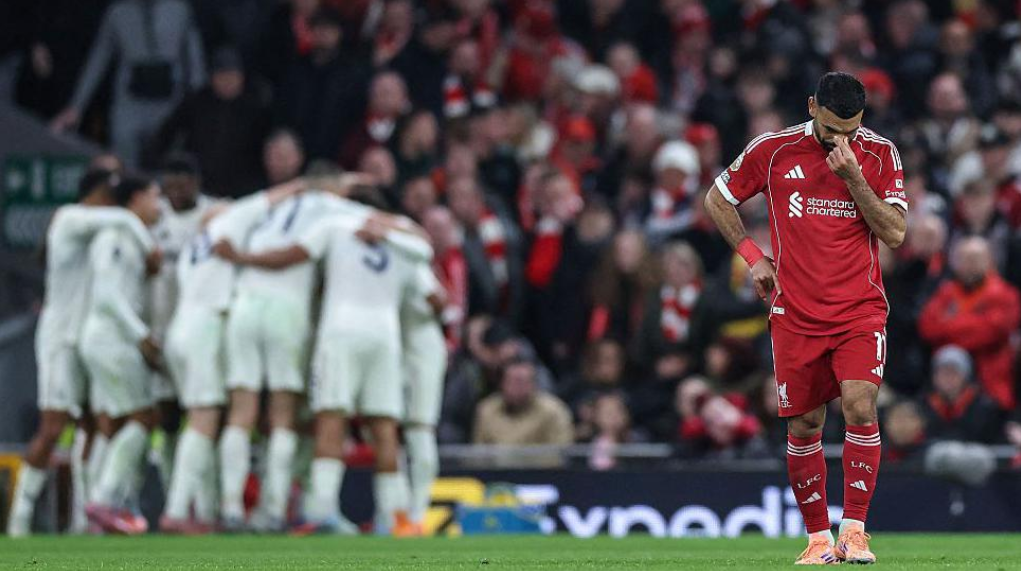
What is happening with Liverpool?
Saturday’s 3-0 loss to Nottingham Forest at home marks a troubling trend, as the reigning champions have now dropped six of their last seven league matches.
This defeat ranks as one of Liverpool’s heaviest home losses in the Premier League era, leaving them sitting in 11th place on the table.
So, what led to this downfall for Arne Slot’s team, and how did Sean Dyche’s strategies exploit their vulnerabilities?
Disorganized Defense on Set-Pieces
Nottingham Forest capitalized on Liverpool’s struggles with set-pieces to score first.
Aside from penalties, Slot’s side has now allowed nine league goals from set-pieces this season, matching the total conceded throughout the entirety of last season.
For their opening goal, Liverpool had six players crowded in the six-yard box, including goalkeeper Alisson, while Forest only had two players positioned within the area.
One of these players applied light pressure to Alisson, while another engaged Virgil van Dijk, restricting his mobility.
Meanwhile, a crucial confrontation took place in the center of the box, where Forest established a 4v4 setup against Liverpool’s Cody Gakpo, Alexis Mac Allister, Dominik Szoboszlai, and Mohamed Salah.
Early in the sequence, Salah signaled to Mac Allister to cover one of Forest’s key threats, Murillo. However, Mac Allister couldn’t disengage from the man he was assigned to mark, effectively leaving Murillo unaccounted for before the corner was taken.
Szoboszlai was supposed to track Morgan Gibbs-White but opted to follow Murillo instead, abandoning his designated mark at the critical moment.
Mac Allister marks his immediate opponent, while Murillo moves behind him into space. Szoboszlai mistakenly opts to track Murillo instead of Gibbs-White [BBC]
After the cross was delivered, Gibbs-White narrowly avoided scoring at the near post while unmarked.
This opportunity arose because van Dijk was occupied, and Szoboszlai had chosen to focus on Salah’s man, rather than Gibbs-White.
The inswinging cross, combined with the players’ simultaneous movement toward the goal, forced Liverpool to retreat, allowing Murillo to find space and score with little resistance.
Gibbs-White remains free at the near post while Murillo separates from Szoboszlai, and Salah has failed to mark his assigned man [BBC]
Ultimately, the lack of communication among Liverpool’s defenders, particularly with Salah’s failure to track his man, opened the door for Forest to capitalize on this weakness.
There are valid questions as to why Salah was assigned this role given his higher attacking potential and tendency to contribute on the counter.
Intelligent Movement Dissects Liverpool’s Defense
For Forest’s second goal, Salah’s defensive shortcomings were again taken advantage of.
Forest managed to position three players on the left side, and Liverpool matched them with Salah, Curtis Jones, and Szoboszlai.
However, instead of defending their zones effectively, Liverpool focused on marking their direct opponents, allowing Forest to use movements and rotations to disrupt their organization.
Jones should have occupied a more conservative position, focusing on the area at the edge of the box instead of following his direct opponent [BBC]
Gibbs-White’s movement from central midfield out to the left effectively drew Ryan Gravenberch away from his position.
Meanwhile, Neco Williams, originally marking Salah, made an untracked run into the middle.
This forced Mac Allister to abandon his central midfield role to pick up Williams.
Mac Allister moves to cover Williams, abandoning his central position [BBC]
As Forest advanced, they flooded the box with players, forcing Liverpool to retreat and create space in front of their back line for Nicolo Savona to score unmarked.
While the first and second goals had different contexts, they both showcased two common problems.
Firstly, Salah lost track of his assigned man during both sequences, and secondly, space opened for the scorer while Liverpool’s defensive line dropped back without adequate coverage.
Last season, Salah’s attacking contributions may have overshadowed his defensive deficiencies, but with Liverpool now struggling offensively, this imbalance raises alarms.
Lack of Intensity
Forest’s third goal was set up with a swift switch to Omari Hutchinson, who found himself in space on the wing.
Hutchinson received the ball facing Liverpool’s goal, possessing both time and room to charge forward.
This scenario echoed in Manchester United’s first goal against Liverpool earlier this season, where Amad Diallo found space to convert effectively.
Such instances are highly challenging to defend against since they allow the winger to dictate the play.
In an ideal situation, a full-back would work to obstruct the opposition by preventing the ball from reaching the winger or forcing the play from an unfavorable angle.
Amad’s success earlier this season against Liverpool demonstrates the vulnerability of their defensive setup [BBC]
Hutchinson’s skill was evident as he maneuvered inside Andy Robertson and unleashed a shot that Alisson managed to block.
Notably, Mac Allister’s positioning became crucial; in attempting to block the shot, he vacated the central area in front of Liverpool’s defense.
This space became the ideal opportunity for Gibbs-White to score unopposed.
A similar pattern contributed to all three goals, indicating a significant issue that Liverpool needs to address, among other concerns.
Defensive players could be more proactive in blocking shots, preventing opportunities before they arise, or a more defensively astute midfielder could focus on protecting the central areas.
Hutchinson prepares to strike following his run into the Liverpool area [BBC]
Forest Shines in Significant Victory Under Dyche
With the third goal, Slot’s substitutions skewed the formation heavily toward attack, leaving Mac Allister without enough defensive support.
Thus, the blame cannot solely rest on him for the losses.
However, the goals conceded against Forest highlight a notable lack of balance, intensity, and cohesion—factors that have historically contributed to Liverpool’s success.
Nonetheless, credit must also be given to Forest for their impressive display.
Their physicality, readiness to challenge for second balls, and relentless movement off the ball were instrumental in securing a commanding victory.