



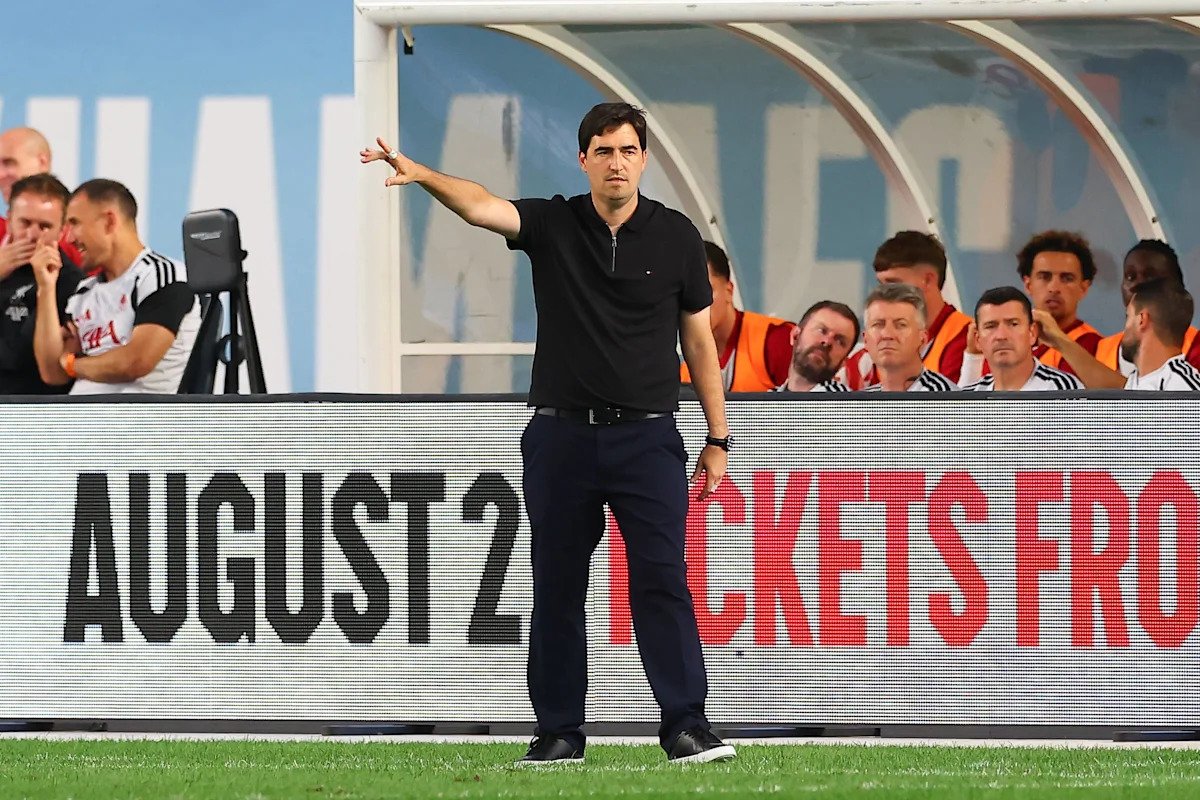
Liverpool Transfer Strategy Puts Andoni Iraola Under Significant FSG Challenge
Liverpool has put considerable trust in Andoni Iraola’s capability to enhance the existing squad, yet there’s a growing consensus that the new head coach may need greater support from the transfer market.
Advertisement
Paul Joyce of
The Times indicates that the Liverpool hierarchy remains optimistic that Iraola can tap into the unrealized potential within a team that significantly underperformed last season. This confidence seems to be shaping Fenway Sports Group’s strategy as they gear up for the Premier League season.
Liverpool has previously taken similar stances and come out justified. However, the situation Iraola is stepping into is far from advantageous.
As Joyce observes:
“Minor adjustments no longer seem like a viable option.”
After finishing fifth last season and losing nearly a third of their Premier League matches, Liverpool struggled with fundamental elements of their play, which ultimately led to Arne Slot’s dismissal on May 30.
Advertisement
Consequently, Iraola faces a substantial rebuilding task.
Joyce’s viewpoint is fitting:
“The extent of the work that Iraola must undertake appears substantial.”
Liverpool’s Transfer Activities Raise Major Concerns
In the past, Liverpool has often thrived by rejecting calls for unnecessary signings.
Adrián and 16-year-old Harvey Elliott were signed in the summer of 2019, while Federico Chiesa was the sole senior addition in 2024. Following these windows, Liverpool went on to secure the Premier League title.
At that time, continuity made sense. Jürgen Klopp had built an outstanding squad that had just claimed the Champions League and was nearing its peak.
Advertisement
Slot also enjoyed continuity upon his arrival in 2024 and led the team to a Premier League victory in his first campaign.
However, Liverpool’s position in 2026 feels markedly different.
So far this summer, the notable additions are Victor Muñoz and Jérémy Jacquet, while attempts to bolster their attacking lineup have proved challenging.
A €100 million bid was made for Yan Diomandé, comprising €80 million upfront and €20 million in performance-related bonuses. However, RB Leipzig sought around €130 million, leading to the winger eventually signing for Real Madrid at €125 million plus an additional €15 million in add-ons.
Advertisement
Liverpool then shifted their focus to Bradley Barcola.
Reports suggest Paris Saint-Germain values Barcola between €150 and €170 million, a figure Liverpool deems excessive. They are also interested in Barcola’s teenage teammate, Ibrahim Mbaye.
Finding another winger has become increasingly critical following Mohamed Salah‘s transfer to Trabzonspor.
FSG’s Spending Practices Face Growing Criticism
Liverpool’s predicament cannot be simplistically attributed to FSG’s unwillingness to spend.
Joyce reports that the expenditure since May 2025 may have reached £550 million, with about £225 million recouped from sales.
Advertisement
Last summer featured significant investments in talents such as Alexander Isak, Florian Wirtz, Hugo Ekitike, and Milos Kerkez. Liverpool remains confident that these players can exhibit considerable improvement in Iraola’s first season.
Photo IMAGO
Nevertheless, Joyce raises a crucial point regarding the overall squad composition:
“That raises significant questions about how this money has been allocated.”
This could become a pivotal issue.
Liverpool could have feasibly invested another £100 million on Barcola and still faced critical questions about their defensive depth.
Advertisement
Iraola was brought in partly due to the belief that his coaching would drive progress.
During the team’s tour in the United States, the former Bournemouth manager discussed the necessity of establishing a robust tactical framework.
“We need a system that provides us with a foundation,” he remarked. “So even if we don’t perform at our best, the system supports us, keeping our standards high.”
“Let’s work on elevating our baseline and when we perform exceptionally, it becomes remarkable. Trusting the players is key and luckily, I have exceptional talent at my disposal.”
Advertisement
After last season, Liverpool desperately needs to raise that baseline.
Defensive Concerns May Undermine Liverpool
Perhaps the most alarming aspect of Liverpool’s current squad lies in their defense.
Iraola has 24 first-team players, but Ekitike, Conor Bradley, Giovanni Leoni, and Jacquet are returning at varying stages after lengthy injuries.
Joe Gomez will start the campaign sidelined due to another muscle injury.
This leaves Virgil van Dijk, now 35, as the sole reliable center-back for Iraola.
Liverpool has invested heavily in Jacquet and Leoni, whom they consider among Europe’s top young central defenders, yet neither has experience in the Premier League or Champions League.
Advertisement
Additionally, crucial context surrounds Jacquet’s acquisition. Liverpool secured that deal while expecting Ibrahima Konaté to stay at Anfield, but contract discussions fell through, resulting in Konaté departing for free.
Bradley’s injury has been known since January, and Gomez’s recurring fitness struggles are not new. Reports suggest Liverpool might seek one player capable of providing cover at both center-back and right-back.
The pressure is mounting.
Joyce’s caution regarding Liverpool’s approach is particularly striking:
“If Iraola cannot get Liverpool competing for top honors, then FSG’s position (and Edwards’s previous claims that the club is well-placed) will be severely called into question.”
Advertisement
This encapsulates the risk Liverpool is undertaking.
Iraola was hired based on his capacity to develop players, organize teams, and establish a cohesive tactical identity.
As Joyce concludes:
“While Iraola was chosen for his ability to enhance player performance, having additional talent to work with would significantly aid his efforts.”
Our Perspective – Anfield Index Insights
From a Liverpool supporter’s viewpoint, this report should spark both enthusiasm for Iraola and genuine concern regarding the expectations placed upon him.
The squad has notable quality.
Isak and Wirtz are expected to evolve into key players. Ekitike possesses immense potential, while Gravenberch, Mac Allister, Kerkez, and Gakpo can all significantly improve their performances from last season.
Advertisement
Iraola’s coaching may make a substantial impact.
His remarks about establishing a tactical “floor” are particularly compelling given that Liverpool’s poorest showings last season often lacked that stability. The team frequently appeared vulnerable during chaotic match scenarios.
However, coaching alone cannot remedy every issue.
Having Van Dijk as the only reliable center-back as the season commences should raise concerns for everyone. While he remains an elite defender, at 35, there’s only so much he can do to maintain defensive solidity on his own.
Liverpool was aware of Bradley’s injury from January and Gomez’s ongoing injury issues. They were also conscious of the risks related to Konaté’s contract situation.
Thus, acquiring another defender feels less like a luxury and more like a necessity.
Barcola would be incredibly exciting, especially after Salah’s exit, and Mbaye represents a potentially excellent investment in Liverpool’s future. Yet, balance across the squad is crucial.
FSG has made significant financial investments. The concern now shifts from whether Liverpool spends adequately to whether that spending has created a squad capable of contending across all competitions.
Iraola deserves the opportunity to prove why Liverpool wanted him.
Enhancing player performances should become a strategic advantage for Liverpool, rather than a justification for unresolved gaps.
Advertisement
If Liverpool manages to secure a top winger and a versatile defender before the transfer window closes, the dynamics of this squad could change remarkably.
Should they fail to do so, Iraola may find himself accountable for issues that effective coaching alone cannot resolve.