



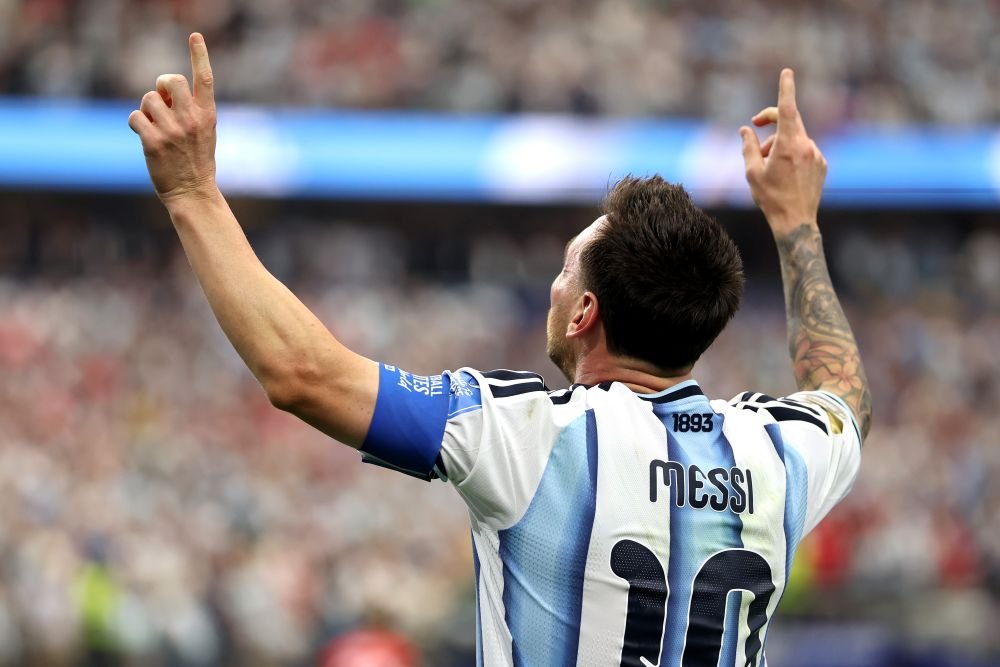
When Lionel Messi first took the field for Argentina back in August 2005, few could have envisioned the remarkable trajectory of his career. However, his undeniable talent hinted at greatness, and on a sweltering day in Texas, at the age of 38, he achieved yet another milestone, surpassing Miroslav Klose’s record to become the all-time leading scorer in World Cup history.
Moreover, he also surpassed the iconic Marta’s World Cup scoring record, establishing himself as the top scorer across both men’s and women’s competitions in World Cup finals history.
Advertisement
Messi’s debut for Argentina was far from flawless; as an 18-year-old, he received a red card just two minutes into his first senior appearance against Hungary.
Fast forward twenty-one years, and Messi had the opportunity to break the record from the penalty spot in the ninth minute, but missed the chance, hitting the ball wide. This moment allowed him to set the record in classic Messi style—initiating the play, deftly maneuvering into space to evade defenders, and then driving to the edge of the box to slot the ball into the bottom corner with his left foot, capping off a beautifully orchestrated La Albiceleste goal.
This goal marked his sixth consecutive World Cup match with a goal, building on his stunning performance that secured Argentina’s third World Cup title.
Messi is competing in his sixth World Cup, a journey that commenced in Gelsenkirchen in 2006 when he came off the bench during a 6-0 triumph over Serbia & Montenegro.
Advertisement
That day, he made history by becoming Argentina’s youngest-ever World Cup goalscorer. After a lovely play between Hernan Crespo and Carlos Tevez, Messi utilized his incredible speed to evade a defender and scored, marking the start of his World Cup journey.
In 2010, Messi and Argentina traveled to South Africa in hopes of clinching their first World Cup since 1986, under the legendary Diego Maradona’s management. The tournament was turbulent for the South Americans and for Messi.
Although Messi did not score in South Africa, he showcased his playmaking talents in the round of 16 against Mexico, dropping deep to assist Tevez in a 3-1 victory, and captained the team for the first time in a 2-0 win over Greece.
In 2014, on South American soil in Brazil, Messi left a larger imprint on the tournament with goals as Argentina advanced to the final, narrowly losing to Germany after extra time.
Advertisement
He initiated the tournament with a goal against Bosnia and Herzegovina in a 2-1 win, followed by a last-minute winner against Iran in a frustrating 1-0 encounter. The final group match showcased Argentina’s attacking prowess in a 3-2 triumph over Nigeria, where Messi scored twice.
In the knockout phase, Messi did not score but contributed an assist in the match against Switzerland, propelling Argentina to their first World Cup final since 1990.
The 2018 World Cup cycle was tumultuous. On the last day of qualification, Argentina needed a win against Ecuador to qualify for the tournament.
Things started poorly as Romario Ibarra put Ecuador ahead. However, Messi then orchestrated a stunning hat-trick to ensure Argentina’s qualification for Russia.
Advertisement
Argentina’s issues during qualification were evident in the World Cup itself. They drew with Iceland and suffered a 3-0 defeat to Croatia. A narrow 2-1 victory over Nigeria clinched their spot in the round of 16, where they faced France in a dramatic match.
Messi did not score but provided two assists during a thrilling 4-3 defeat. Argentina’s exit in the round of 16 was a disappointing conclusion to a tumultuous campaign. Yet, this would mark the beginning of a new chapter for both the Argentine national team and Messi’s international career.
In 2021, Messi and Argentina secured the Copa América title at the Maracanã in Brazil, a landmark moment and a significant turning point in the Argentine national team’s journey. This victory marked their first major trophy since the 1993 Copa América, ending 28 years without international silverware.
The Copa América triumph catalyzed Argentina’s subsequent success. Their qualification campaign for the 2022 World Cup was far smoother compared to their struggles in 2018.
Advertisement
Yet, the World Cup started on a sour note, with a shocking 2-1 loss to Saudi Arabia. Messi put Argentina ahead with a penalty, but the Saudis staged an incredible comeback to win the match.
Against Mexico, Messi found the net and provided an assist before Argentina capped off Group C with a 2-0 victory over Poland.
In a tense encounter with Australia, Messi scored the opening goal in a 2-1 win. The quarter-final against the Netherlands saw Messi excel again, contributing a goal and an assist as Argentina appeared to be in control at 2-0, before the Dutch equalized, leading to a penalty shootout, which Argentina won 4-3.
The semi-final was a more straightforward affair for Argentina, securing a 3-0 victory over Croatia with Messi contributing a goal and an assist, propelling La Albiceleste to their first World Cup final since 2014.
Advertisement
The final against France was a classic, with Argentina initially taking a two-goal advantage. Messi scored from the penalty spot, and Ángel Di María doubled their lead.
However, France made a comeback in the second half, scoring twice in a game that Argentina had mostly dominated. In extra time, Messi’s superb play allowed him to poke the ball past Hugo Lloris.
Yet, France responded yet again, leading the match to be decided by a penalty shootout. Argentina maintained their composure, winning the shootout and finally allowing Messi to claim his first World Cup title.
The maestro has begun this World Cup impressively. He appears driven and threatening, continuing to be at the core of Argentina’s accomplishments.
Advertisement
With five goals for both Argentina and Messi, the eight-time Ballon d’Or winner looks formidable as ever. It will be intriguing to see how the prodigy from Rosario concludes his World Cup journey, should this indeed be his last.