



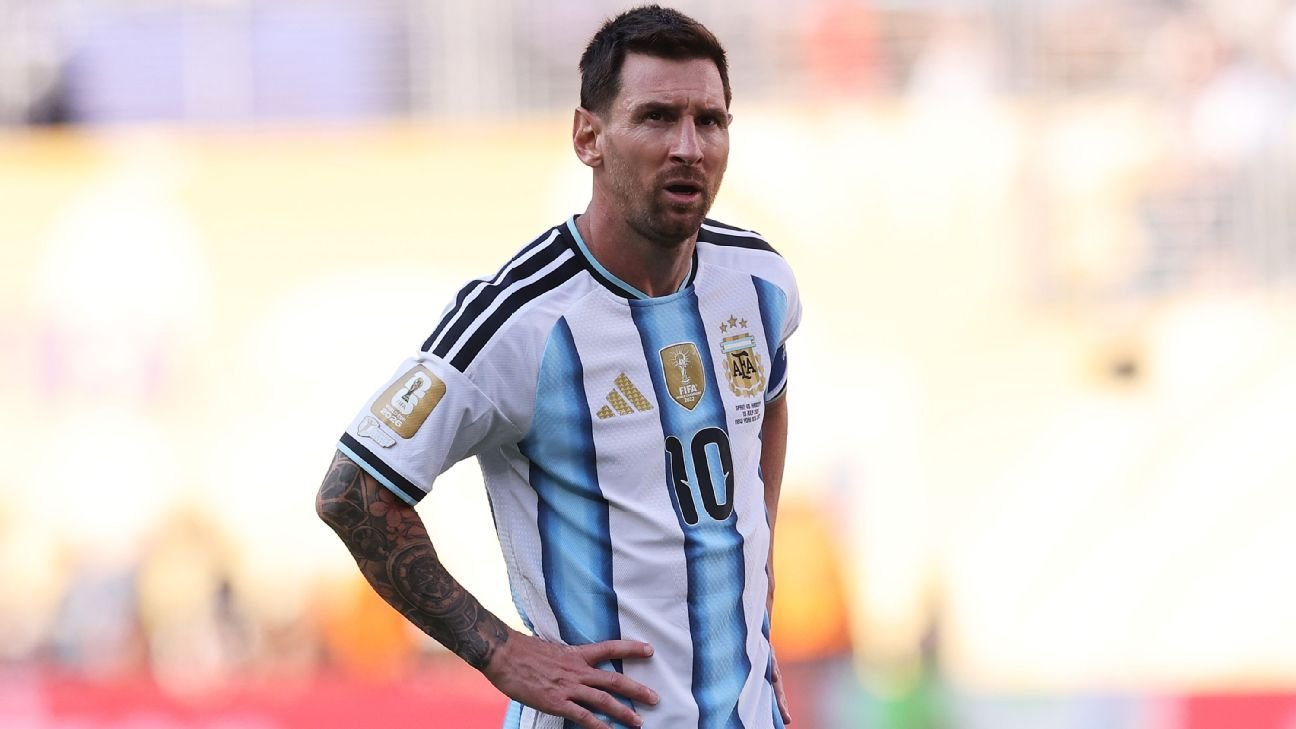
In terms of pure soccer, there is little debate: the pinnacle of Lionel Messi was undoubtedly during his mesmerizing performances while donning the Barcelona jersey from 2005 to 2021. Throughout this lengthy tenure, Messi reached the zenith of his talents, thriving in an environment uniquely suited to his abilities. Few moments in soccer history can rival the beauty of his display on the field.
However, one could argue that his recent years playing for Argentina might be even more remarkable. This notion stems from the profound emotional connection that comes with representing a nation as passionate about soccer as Argentina, which adds a significant weight to his performances.
Moreover, Messi’s international journey transcends mere natural talent; it tells the story of a man striving to conquer challenges and modify his approach to navigate frustrations, ultimately leading to lasting success.
It has been over 21 years since Messi first took to the pitch for Argentina in a competitive match — a call-up for the South American Under-20 Championships in Colombia at the beginning of 2005.
At that time, even Argentina knew little about him. Although he had been with Barcelona for four years and had made a handful of first-team appearances, speculation about his potential was just starting to swirl. Spain was keen on him, prompting Argentina to act decisively to secure his services — then just a boy of 17.
Despite being two years younger than his competitors and physically underwhelming, Messi soon showcased that the hype was not only justified but had fallen short of capturing his true talent.
Two qualities were immediately apparent: one, the ball seemed inseparable from his left foot, as if it were an extension of his own being; and two, his exceptional spatial awareness enabled him to navigate the field masterfully, allowing him to devastate opponents. Alongside his close friend Sergio Agüero, Messi led Argentina to victory in the FIFA U20 World Cup in the Netherlands a few months later.
His rapid rise quickly positioned him as Argentina’s next big hope, culminating in his debut for the senior team against Hungary in August 2005. Coincidentally, this match featured the same opponent that Diego Maradona faced in his inaugural international outing.
While Maradona celebrated a 5-1 victory, Messi’s debut was far less fortunate. Coming on as a substitute, he soon dazzled on the pitch until he was harshly sent off for a supposed elbowing incident after attempting to free himself from a defender’s grip, resulting in an international debut lasting barely five minutes.
This incident nagged at him over the years, leading to a brief retirement from international play as he struggled with a string of setbacks. In the 2006 FIFA World Cup, he was relegated to the bench as Argentina lost to Germany in penalties during the quarterfinals.
In 2010, the same adversary returned for another quarterfinals clash, resulting in a devastating 4-0 defeat, exacerbated by coach Maradona’s tactical errors. Then came three consecutive finals losses over three years: a 1-0 defeat to Germany in the 2014 World Cup, a penalty shootout loss to Chile in the 2015 Copa América, and another agonizing shootout loss to the same nation the following year in a special centenary tournament held in the United States.
In that particular shootout, Messi’s shot soared over the crossbar. Following that game, in the same New Jersey stadium where his international career would culminate years later, he announced his retirement from the national team.
Yet, he returned and, unfortunately, things would deteriorate before they improved. The nadir came in the 2018 World Cup, where Argentina drew with Iceland, suffered a heavy defeat against Croatia, and lost to France by a score that misrepresented the thrashing they endured. At this point, Messi, already over 30, had yet to score in a knockout match in World Cup history.
His struggles with the national team fueled criticism globally; would he even dare to try again?
No one could have foreseen that Argentina was on the verge of entering the most successful era in its history. This was particularly surprising given that their new coach, Lionel Scaloni, was an inexperienced choice primarily due to budget constraints.
However, Scaloni and Messi diagnosed the team’s issues and sought a solution. With veteran Carlos Tevez’s departure from the squad, Messi emerged as the undisputed focal point. Many of the younger players idolized him, eager for his acknowledgment and praise. Messi, typically reserved and self-contained, communicated little, often just with his longtime friend Agüero.
Scaloni was hesitant initially to select Agüero and sought to draw Messi out of his shell. Thankfully, Messi was receptive to this coaxing, perhaps influenced by his deteriorating relationship with Barcelona, leading him to prioritize the national team. The Argentine public and his teammates noticed this shift.
The pivotal moment came during the 2019 Copa América in Brazil, Scaloni’s first tournament as head coach. Argentina’s poor start gave way to a clearer tactical framework as the tournament progressed. While they finished third, they emerged as long-term victors. Journalists covering Argentina were astonished by Messi’s transformation — he had become much more vocal.
He had transformed into the vocal leader the team needed — a role he hadn’t embraced naturally, but recognized as necessary and worked diligently to fulfill.
“I like this Messi,” said Ángel Di María to the Argentine press soon after the tournament, indicating that it took over a decade for their relationship to reach this level of synergy. The team evolved into Messi and his supporters; they were devoted to him, and he reciprocated their loyalty.
Following a long wait for a senior title since 1993, Argentina started accumulating silverware: winning the Copa América in 2021, followed by the Finalissima, and ultimately claiming the coveted 2022 World Cup. They added another Copa América in 2024 and currently stand atop South America’s 2026 World Cup qualifying campaign, leading to the tournament final a few weeks ago in New Jersey.
The general sentiment in Argentina this week is one of deep gratitude. Perhaps we should all feel thankful too. Messi could have walked away from international soccer in 2016 or 2018, but he persevered, gifting us nearly five years of unforgettable memories, the result of not only his remarkable natural talent but also his relentless desire to improve in areas of weakness.