



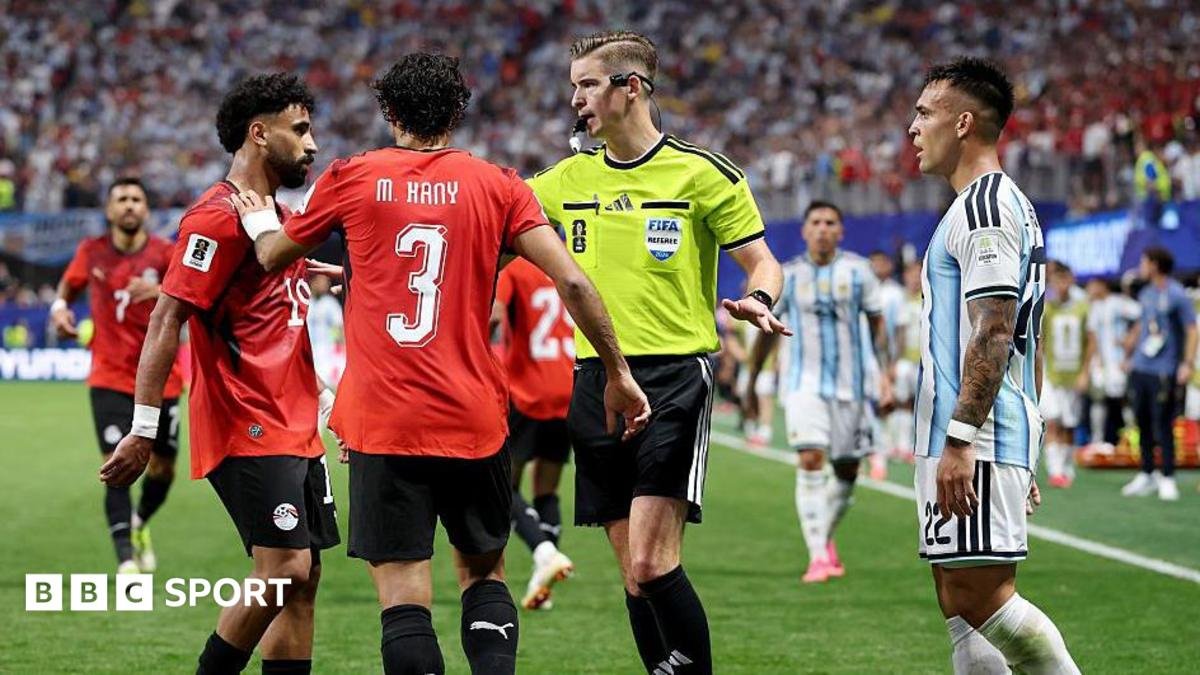
With Egypt 1-0 up in the second half against Argentina, VAR cancelled out a strike by Mostafa Zico after ruling that midfielder Marwan Attia had stepped on Lisandro Martinez’s foot in the buildup.
An appeal for a foul on Mohamed Salah in Argentina’s penalty area was also dismissed, seconds before the defending champions countered to score the stoppage-time winner.
Although he typically avoids discussing specific incidents during major tournaments, Collina supported both calls.
“After each goal, the VAR reviews the attacking possession phase (APP). If a foul is identified in the buildup and deemed to have influenced the goal, the VAR will recommend an on-field review,” he said.
“There is no fixed limit on either the distance from goal or the time between the incident and the goal.
“One example came in Argentina v Egypt, where Egypt number 19, Marwan Attia, clearly stepped on the foot of Argentina number six, Lisandro Martinez.
“We believe a foul is a foul. Even if it isn’t ‘obvious’, if the referee didn’t spot it on the field, VAR can step in.
“Likewise, if no foul is found in the buildup to a goal, the VAR will inform the referee. Standing on an opponent’s foot is a foul, whereas a defender who plays the ball first and then makes normal football contact has not committed a foul.
“We saw this again at the end of the same match, when the referee and VAR judged the contact between Egypt number 10 Mohamed Salah and Argentina number 9 Julian Alvarez to be normal play.
“There will always be some subjectivity in certain decisions, but we are satisfied with how this principle has been applied throughout the tournament.”