



-

Beth Lindop
Multiple Authors
“Only Mohamed Salah.” These words have become closely associated with the iconic Egyptian forward throughout his illustrious career.
Over his nine remarkable years at Liverpool, that phrase emerged each time he shattered a record. Whenever his fellow Premier League contemporaries achieved significant milestones, they often found themselves needing to contend with the inevitable comparison to Salah.
Only Mohamed Salah had run the hardest, dribbled the fastest, or shot the most accurately. Only Mohamed Salah had the audacity to aim for historical greatness and secure it, closing each chapter with his unmistakable flair.
– World Cup bracket: Every team’s route to the final
– Penalty heartbreak as knockout win still eludes Socceroos
– Golden Boot tracker: Who will end as top goal-scorer?
In Egypt’s thrilling round-of-32 match at the FIFA World Cup against Australia, Salah found a new path to tread. With both teams at a stalemate, 1-1 after extra time in Dallas, the 34-year-old seized the moment to take Egypt’s third penalty, aware that failing to score would allow Australia to capitalize on an earlier miss by Harry Souttar.
In such a high-pressure situation, many players might falter. Others might rush to hit the ball blindly. However, Egypt’s captain composed himself, adjusted his shin guards, and confidently executed a ‘Panenka’ chip straight into the middle of the goal, slipping past the diving Mathew Ryan.
Who would dare to take such a gamble while carrying the hopes of a nation? Clearly, only Mohamed Salah.
“If someone was going to do it, it had to be me,” Salah remarked to BBC Sport about his audacious penalty style following the match. “I have more experience than others, and I wanted to instill confidence in my teammates. I made my decision in the last moment; it was necessary.”
This confident attitude has characterized Salah’s transformation from a Chelsea prospect to a worldwide icon, and it proved vital against Australia as Egypt celebrated its first advancement beyond the World Cup group stage.
“This is historic,” Salah said. “I told the team before the game that this is the biggest platform to showcase your talent. Enjoy it and don’t let pressure affect you. I’m thrilled we achieved this win. It’s unfortunate for Australia to lose on penalties, but I’m proud we made history today.”
This tournament has already etched itself into Egypt’s memory. Despite their considerable success in the Africa Cup of Nations, the Pharaohs have historically underperformed on the World Cup stage.
Last week’s 3-1 victory over New Zealand marked Egypt’s first World Cup win since their debut in 1934. They have also become the second African nation to secure a World Cup penalty shootout victory—following Morocco in 2022—and just the fifth African team to advance to the knockout phase (joining Cameroon, Senegal, Ghana, and Morocco again in 2022 and 2026).
No matter what happens next, this summer will be remembered in the annals of Egypt’s sporting history. However, the enticing prospect of extending this journey awaits as they prepare for a round-of-16 match against Argentina.
Facing the reigning world champions and their captain Lionel Messi is an exhilarating challenge. Messi’s remarkable ability to influence matches means he operates on a different plane than most of his competitors, yet Salah is unlikely to underestimate his own talents.
0:35
‘One of the best days of my life!’ – Salah after World Cup knockout win
This season has been tumultuous for the former Liverpool player, who now finds himself without a club after departing Anfield in May. Salah dealt with fluctuating form last term, attracting significant criticism, and has increasingly shown signs of feeling the effects of time.
Nonetheless, up until the match against Australia concluded, he had created more opportunities at the 2026 World Cup than any other player, tallying 16 chances (tied with Belgium‘s Leandro Trossard). Salah’s fitness was uncertain prior to Thursday’s match following a hamstring issue that forced him off against Iran, but he persevered, playing the entire 120 minutes against Australia and exhibiting the resolve to take and score his penalty.
He ended the game with eight touches inside the box—more than any other player—and nearly registered a match-winning assist, but his exquisite cross for Ramy Rabia was thwarted by a stunning save from Australia’s Patrick Beach in the 94th minute.
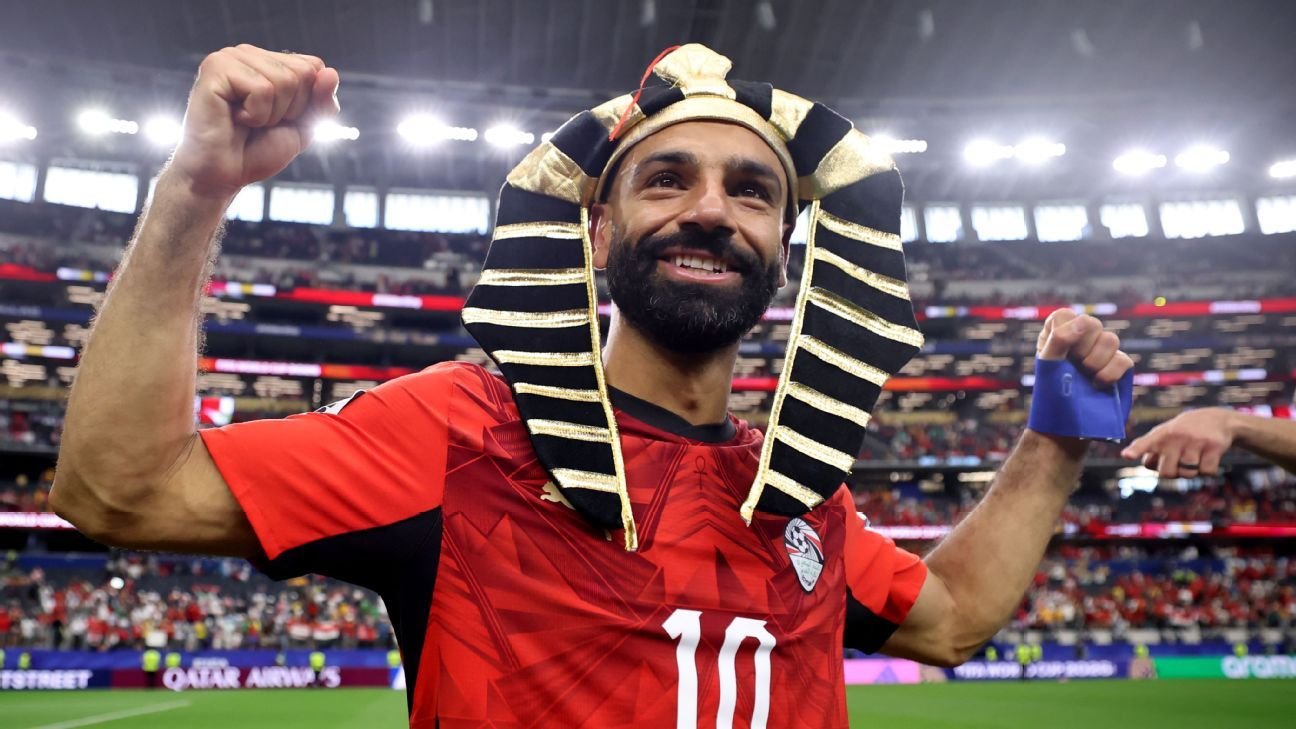
Following the final whistle, it was no surprise that Salah was at the center of Egypt’s celebrations, even donning a Tutankhamun-style headdress as he reveled on the pitch with teammates. Prior to this, he took a moment to acknowledge the supporters, visibly moved as he completed a lap of honor around Dallas Stadium.
The emotional weight of the occasion felt especially poignant given it marked a year since the tragic car accident that claimed the lives of Salah’s Liverpool teammate Diogo Jota and Jota’s brother Andre Silva. Salah had previously referred to the incident as “the hardest time in our lives,” serving as a reminder that his challenges on the field may have been compounded by personal tribulations off it.
Nevertheless, Salah remains a fierce competitor, with the aim of enhancing his already extraordinary career. Messi and Argentina will await in Atlanta on Tuesday, with the defending champions favored to move on to the quarterfinals.
Pulling off what would be a historic upset is a tall order for most players. Yet, possibly only Mohamed Salah holds the hope of turning that dream into reality.