



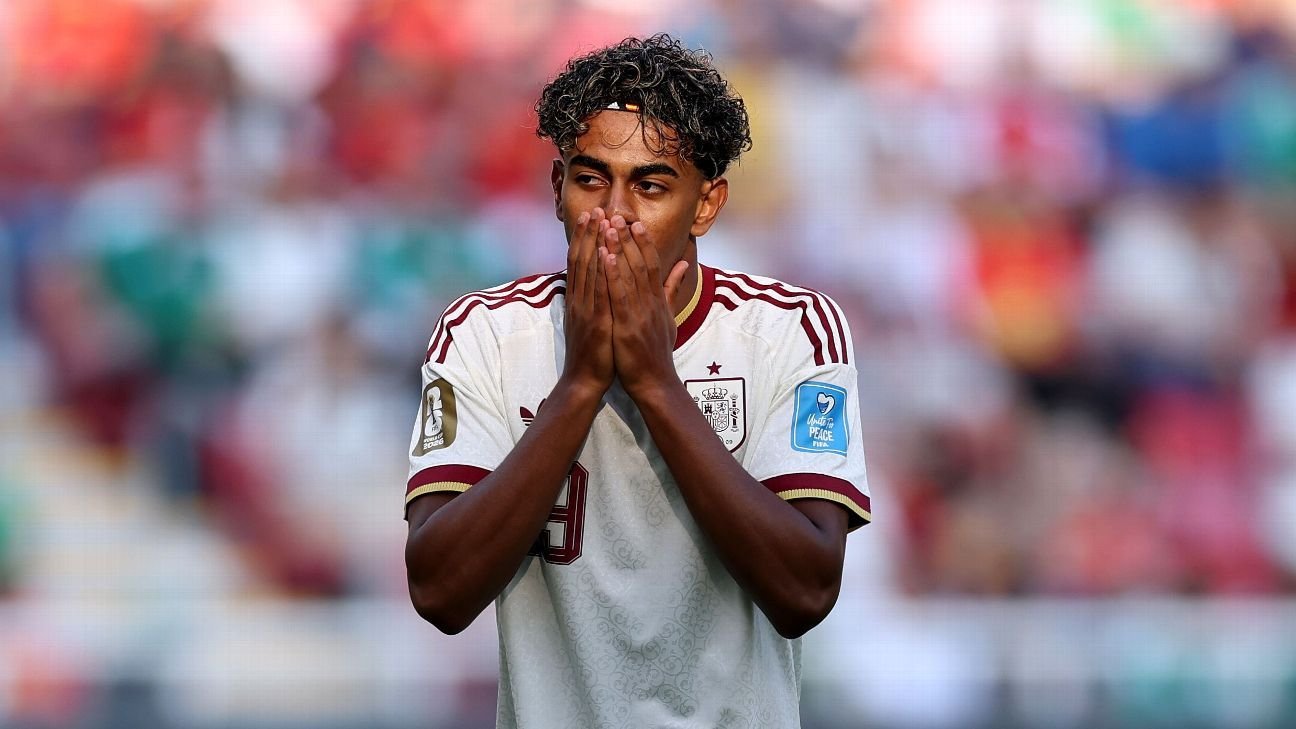
GUADALAJARA, Mexico — Uruguay’s coach, Marcelo Bielsa, had previously praised Luis de la Fuente’s Spain side for playing “exquisite” football, stating that it was “much more beautiful than what I’ve managed,” ahead of their crucial World Cup Group H clash.
However, during Spain’s hard-fought 1-0 victory on a steamy, stormy night in Guadalajara, the expected exquisite football was largely absent.
Following the excitement of their 4-0 victory over Saudi Arabia in Atlanta, featuring a standout performance from Lamine Yamal, this match felt more akin to Spain’s sterile 0-0 draw with Cape Verde.
A goalless outcome seemed possible until a blunder from Uruguay’s Fernando Muslera, who mishandled Álex Baena‘s first-half shot, resulting in an own goal. Bielsa later revealed that Muslera had requested to be substituted at halftime.
“It wasn’t my choice; Muslera made that decision himself,” Bielsa stated post-match.
Since the 2026 World Cup draw was announced, this match had been highly anticipated, featuring the European champions against a historic South American powerhouse. The winner stood to avoid Argentina in the round of 32, providing a more favorable path through the knockout stages.
However, after draws against Saudi Arabia and Cape Verde, Uruguay’s situation had shifted. They weren’t merely contesting for the top spot; they were fighting to remain in the tournament. A loss would mean elimination, and even a draw wouldn’t necessarily secure qualification as one of the third-placed teams.
Conversely, Spain entered this match with optimism following their performance against Saudi Arabia, feeling they were gaining momentum with Yamal’s return.
Yet, the expected progress was not on display in Guadalajara. Instead, it marked a false start.
“Maybe we weren’t as brilliant as we wanted to be or as we’ve shown at other times,” de la Fuente commented afterward. “You can’t always deliver that level of performance in football. However, this was a very demanding match. We were responsible, maintained our focus, composure, and efforts, and avoided being provocative.”
De la Fuente made two changes to his lineup, bringing in Marcos Llorente for Pedro Porro at right back, and Mikel Merino for Dani Olmo in midfield. Unfortunately, neither change positively influenced the game; Llorente struggled to connect with Yamal, and Olmo’s absence was felt, leading to a disjointed performance from Spain.
Uruguay, under Bielsa’s direction in what would be his final match as coach, took a proactive approach. He emphasized the importance of attacking Spain rather than sitting back.
“Allowing them to play freely and giving them possession will favor Spain,” Bielsa said. “Spain performs worse when they have less ball.” Uruguay aimed to press Spain and upset their rhythm. Just one minute into the game, they forced an error from Spain’s goalkeeper, Unai Simón.
Spain began to dominate possession, but their quality in front of goal remained lacking. By the 42nd minute, they controlled 76% of the ball but managed only two shots, both off target. Uruguay had none.
The opening goal came in the 42nd minute due to Muslera’s misjudgment. Baena’s strike should have been easily dealt with but was incorrectly parried into his own goal by the goalkeeper.
The second half saw the match become increasingly hostile. A reckless tackle on Yamal by Uruguay’s Juan Sanabria drew a yellow card, and tensions further escalated when Uruguay’s Agustín Canobbio received a red card for a reckless challenge on Spain’s Pau Cubarsí during stoppage time, igniting a melee between both benches.
Meanwhile, Spain struggled with decision-making. Substitute Olmo fluffed a promising opportunity by shooting wide inside the box, while Yamal’s attempts to dribble through defenders went unanswered. Another substitute, Ferran Torres, struck the crossbar in the closing minutes.
Despite Yamal’s promising showing, along with contributions from Mikel Oyarzabal and Pedri, doubts lingered about this Spanish squad. Concerns particularly centered around their goalkeeper, Unai Simón, who struggled with confidence, mishandling crosses and exhibiting nerves. Both David Raya and Joan García are available options on the bench, but de la Fuente remains committed to Simón.
In midfield, Rodri performed below expectations; despite having the most touches and passes completed, he lacked dynamism and creativity. Merino and Oyarzabal also failed to make an impact, managing just one shot collectively.
On a positive note, Yamal played for 76 minutes, but he couldn’t replicate his previous influence against Saudi Arabia.
Nonetheless, Spain’s challenges are minor compared to Uruguay’s. Bielsa’s side had some opportunities but only created one “big chance,” resulting in an expected goals (xG) tally of just 0.20, and lost their composure late in the match.
“We aimed for seven points and secured just two, which reflects my management and performance,” Bielsa said afterward. “I needed to guide a team of players who are competent but couldn’t extract more from them.”
The Mexican fans relished Uruguay’s difficulties, chanting “Cape Verde! Cape Verde!” near the end, celebrating Spain’s progression into the round of 32.
Spain achieved their goal of topping the group to avoid meeting Argentina, but they will still have to confront a formidable opponent as the tournament progresses.
When that moment arrives — possibly in the round of 16 — they will need to elevate their performance significantly.