



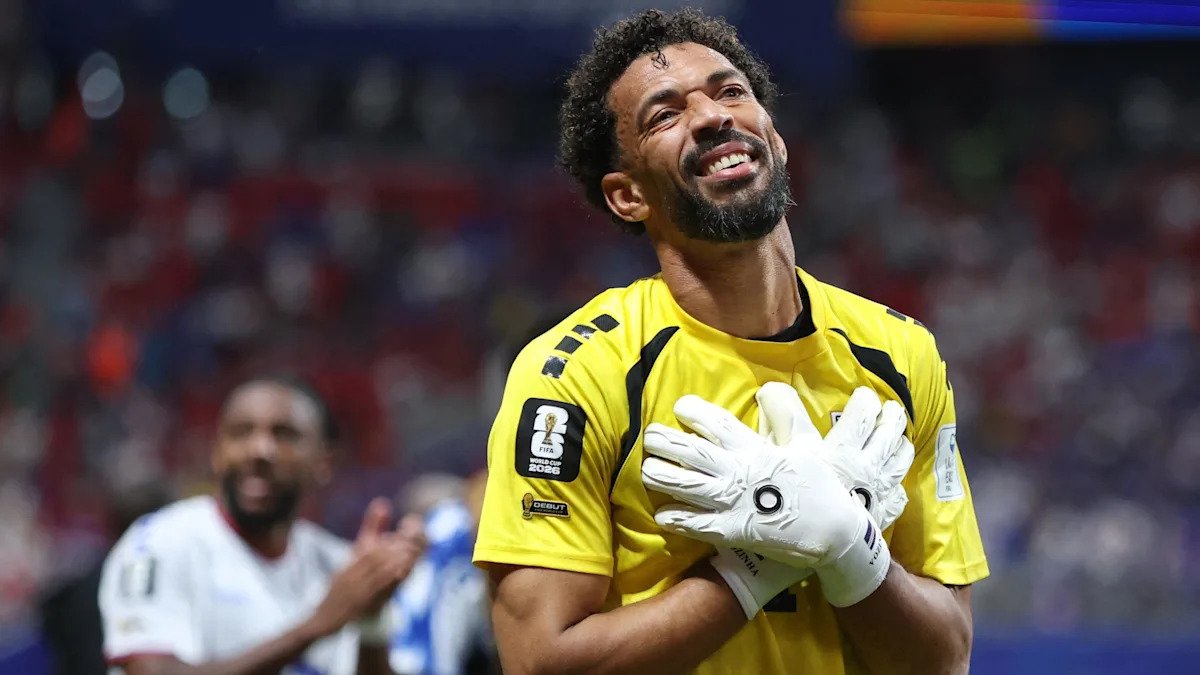
As the final whistle echoed through the Atlanta Stadium, cameras zoomed in on Cape Verde’s goalkeeper, Vozinha.
Tears flowed down the 40-year-old’s cheeks as he began to grasp the significance of his team’s 0-0 draw against World Cup favorites Spain.
Cheers erupted from the stands as thousands of Cape Verde fans, who had passionately supported their team for the full 90 minutes, celebrated the moment—hugging, dancing, and reveling in their achievement.
On the field, players rushed towards one another in sheer euphoria. Even neutral spectators were caught up in the excitement—by the final whistle, many were celebrating as well.
In a match against European champions Spain, Vozinha delivered a legendary performance, achieving a remarkable clean sheet that marked a historic moment for his nation.
“I cried because I grew up with my grandparents,” Vozinha shared after being named player of the match. “Sadly, they weren’t here to witness it; they passed away a few years back. They meant everything to me, to my life.”
“And I also cried for my mum. She couldn’t make it due to visa issues. The cost and timing were too challenging for us. I really wish she could have been here.”
“Our greatest strength is our unity. No matter which player is part of the team today or in 10 or 15 years, how we treat our family is what makes us strong. People thought we came merely to enjoy the World Cup, but we respect every team. This is our debut, but we’re here to compete and fight for our country.”
‘A Dream Since Childhood’
For Vozinha, this moment was a culmination of a lifelong pursuit.
Born Josimar Dias, the Cape Verdean goalkeeper has dedicated his career to realizing his dream of playing in a World Cup.
When that moment finally arrived, it was historic. At 40 years and 12 days, he became the oldest player to ever feature in a nation’s first World Cup match, breaking a record set just the day before by Curacao’s Eloy Room.
Remarkably, only Egypt’s Essam El Hadary was older at the time of his World Cup debut.
This achievement marks a significant milestone in a career shaped by resilience.
“I began my professional career at 25 in 2012, which seemed late for someone like me,” Vozinha reflected.
“I considered stepping back from the national team, but I persevered because of this dream.
“This performance is for everyone. I’m honored to be recognized, but this award belongs to all my teammates, without whom this would be impossible. I will continue to work hard for the team and our supporters.”
Cape Verde, an isolated archipelago nearly 600km off the west coast of Africa, offers limited opportunities for young footballers. Growing up in Mindelo, Vozinha faced many hurdles right from the start.
“I was one of the best goalkeepers on my island but was often overlooked because of my height,” he recalled. “Even impressive performances didn’t guarantee selection.”
Like many before him, he eventually migrated to Portugal, the former colonial power, in search of opportunity. This decision launched a journey across Slovakia, Angola, Moldova, and Cyprus, leading him to his current club, Portuguese second-tier side Chaves.
The name “Vozinha” itself holds a fragment of football history. His father wished to name him ‘Valdano’, after the great Argentine striker and Real Madrid legend Jorge Valdano, but Cape Verdean authorities declined. Instead, he was named Josimar, after the Brazilian defender who gained fame during the 1986 World Cup.
Decades later, at another World Cup, Vozinha has carved out his own place in football history.

Vozinha made seven saves in Cape Verde’s 0-0 draw against Spain [Reuters]
‘Vozinha Shines in the Spotlight’
With the backing of thousands of Cape Verde fans, Vozinha stood resolute against Spain’s unwavering offense, making seven pivotal saves—the only goalkeeper over 40 years old to make more in a World Cup match was Pat Jennings, who had 10 saves on his 41st birthday for Northern Ireland against Brazil in 1986.
Each save was celebrated as if it were a goal by the supporters in the stands.
Beyond the stadium, Vozinha was becoming a viral phenomenon, witnessing his Instagram followers surge from 50,000 to more than 5 million after CazeTV—the World Cup’s rights holder in Brazil—encouraged viewers to follow him.
“That’s insane,” he said when reporters informed him of the spike in followers.
Former Scotland winger Pat Nevin remarked that the goalkeeper “lit up this game”.
“He’s been phenomenal,” Nevin stated on 5 Live. “At 40, he’s the center of attention. His teammates are highlighting his brilliance. It’s a beautiful scene.”
Adding to the excitement, Lee Dixon commented on ITV: “What a fantastic and well-deserved performance. They earned this point, while Spain leaves feeling disappointed. Tonight belongs to Cape Verde.”
For a nation with just over half a million inhabitants, and the third smallest to qualify for a World Cup, this result carried profound significance.
In the stands, supporters mirrored that passion. Dressed in blue and waving their red, white, and blue flags, they sang and celebrated, uplifting their team through each tense moment. By the end of the match, even neutral fans were captivated. Cape Verde’s journey had touched everyone’s hearts.
A small island nation, no bigger than Sheffield, had truly captured the football world’s imagination.