



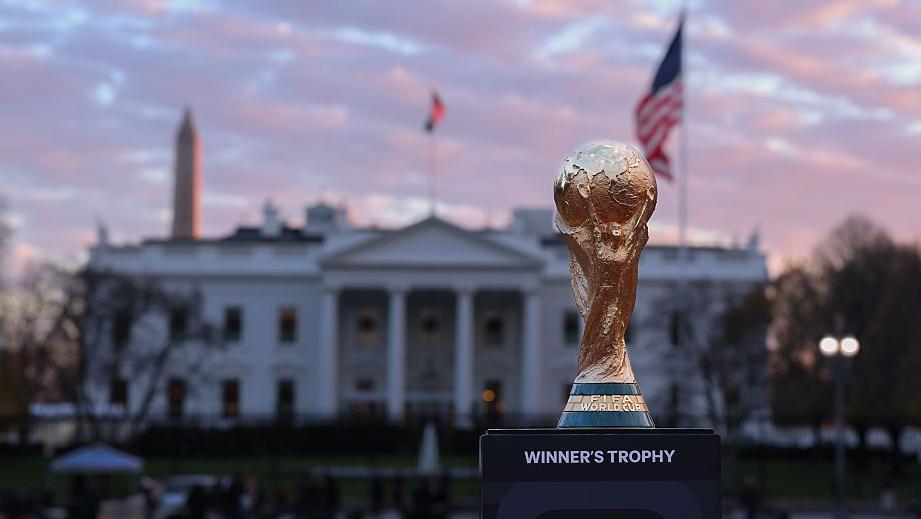
The upcoming 2026 World Cup finals draw on Friday is set to be quite complex, with pots, quadrants, confederation constraints, and group position grids in play.
Don’t worry; we’ll break it down as clearly as possible.
Fortunately, FIFA will employ a computer system to handle the intricate details and ensure the event proceeds smoothly. However, as UEFA discovered in 2021, there’s always a chance for technical glitches.
Let’s hope everything goes off without a hitch in Washington during the draw ceremony.
Here’s how the process will work, what to expect, and several important highlights.
When Does the Draw Start and How Long Will It Last?
The ceremony kicks off at 17:00 GMT (12:00 local time) on December 5. This event will involve much more than simply pulling country names from a hat.
Co-hosted by supermodel Heidi Klum, comedian Kevin Hart, and actor/producer Danny Ramirez, the event will feature live performances by Andrea Bocelli, Robbie Williams, and Nicole Scherzinger, along with speeches from FIFA President Gianni Infantino and US President Donald Trump.
Following these introductions and video highlights from the finalists, former Manchester United and England defender Rio Ferdinand will conduct the draw.
He will be accompanied by broadcaster Samantha Johnson and several sports legends, including Tom Brady, Wayne Gretzky, Aaron Judge, and Shaquille O’Neal.
The ceremony is expected to last approximately 90 minutes, with a performance of “YMCA” by the Village People concluding the festivities.
How Has FIFA Separated Teams for the Draw?
The 48 participating teams are organized into four pots of 12, primarily based on FIFA world rankings. Notably, the three co-hosts are placed in pot one, while teams qualifying through six playoff paths will be in pot four.
Some of the European playoff contenders could lead to particularly strong groups, as Italy and Denmark would have been in pot two based on their rankings had they qualified directly, with Wales in pot three.
The six playoff paths include:
- Uefa Play-off A: Italy, Wales, Bosnia-Herzegovina, Northern Ireland
- Uefa Play-off B: Ukraine, Poland, Albania, Sweden
- Uefa Play-off C: Turkey, Slovakia, Kosovo, Romania
- Uefa Play-off D: Denmark, Czech Republic, Republic of Ireland, North Macedonia
- Fifa Play-off 1: DR Congo, Jamaica, New Caledonia
- Fifa Play-off 2: Iraq, Bolivia, Suriname
How Will the Draw Proceed?
The 12 groups will each feature one team from every pot. FIFA will begin by selecting teams from pot one.
The co-hosts—Mexico (A1), Canada (B1), and the United States (D1)—will have distinct colored balls adorned with their flags to indicate their special status, with their group placements determined to ensure they play all matches in their respective countries.
The draw will then continue sequentially through pots two, three, and four.
Understanding the Separation of Top Teams
FIFA aims to maximize the potential for high-stakes matchups in the later stages of the tournament by implementing a system that segments the top four ranked teams—Spain, Argentina, France, and England.
This arrangement ensures they will not face each other until at least the semifinals, provided they win their groups.
For example, if France is drawn first and placed in Group C, they will occupy the green quadrant, which will restrict England to the blue or turquoise quadrants. If Argentina is placed in the blue quadrant, England will only be able to land in the turquoise grouping.
But this doesn’t necessarily mean an easy path for the top seeds; they could meet another top team in a potential last-16 matchup.
Additionally, should any seeded team finish as a runner-up in their group, they lose this advantageous status.
Key Draw Restrictions to Note
Only one team from each confederation can populate a group—meaning, for instance, Brazil and Uruguay (both from Conmebol) cannot be in the same group. The exception is UEFA, given its larger representation with 16 teams.
As the draw progresses, these restrictions may create complications, particularly as teams avoid certain groupings to comply with confederation rules.
This dynamic means teams in pots three and four may appear to be placed in groups arbitrarily.
What the Draw Process Looks Like
When teams are drawn, they are assigned to the first available group that meets the constraints, in alphabetical order.
FIFA’s computer system will ensure that Spain, Argentina, France, and England are distributed in accordance with their designated quadrants.
To streamline the process, teams will not be placed in specific group positions; instead, seeded teams will fill position one, with other positions predetermined according to a set grid.
For example, if Scotland is drawn from pot three, their order will be determined by the grid positioning.
When Will Teams Know Their Matches?
While teams will learn their opponents and match dates on December 5, they’ll need to wait an additional day to find out specific venues and kick-off times. The co-host groups will already have venues established, but specific times will be released later.
The complete match schedule is set to be disclosed on December 6 at 17:00 GMT (12:00 local time), with FIFA President Gianni Infantino sharing the stage with football legends to discuss pivotal matches.
All 12 groups will engage in fixtures following this schedule:
- Match Day 1: 1 v 2, 3 v 4
- Match Day 2: 1 v 3, 4 v 2
- Match Day 3: 4 v 1, 2 v 3