



SALZBURG, Austria — Saturday, June 6, 2026, is a day that Omar Artan will always remember. On the occasion of his 34th birthday, the referee set off on a journey to the United States, eager to become the first Somali to officiate a FIFA World Cup.
His journey began in the war-torn streets of Mogadishu, where injury halted his dreams of playing football at a young age. However, when Artan arrived at Miami International Airport, instead of achieving his lifelong ambition of representing Africa on such a grand stage, he faced an 11-hour interrogation from U.S. Customs and Border Protection. Despite having a diplomatic passport and a valid visa, he was denied entry and sent back home.
– UEFA reaffirms its stance on the World Cup boycott despite FIFA’s apology
– Could Infantino lose the FIFA presidency after rejection of World Cup plans?
– Why South America is hesitant about hosting the 2030 World Cup
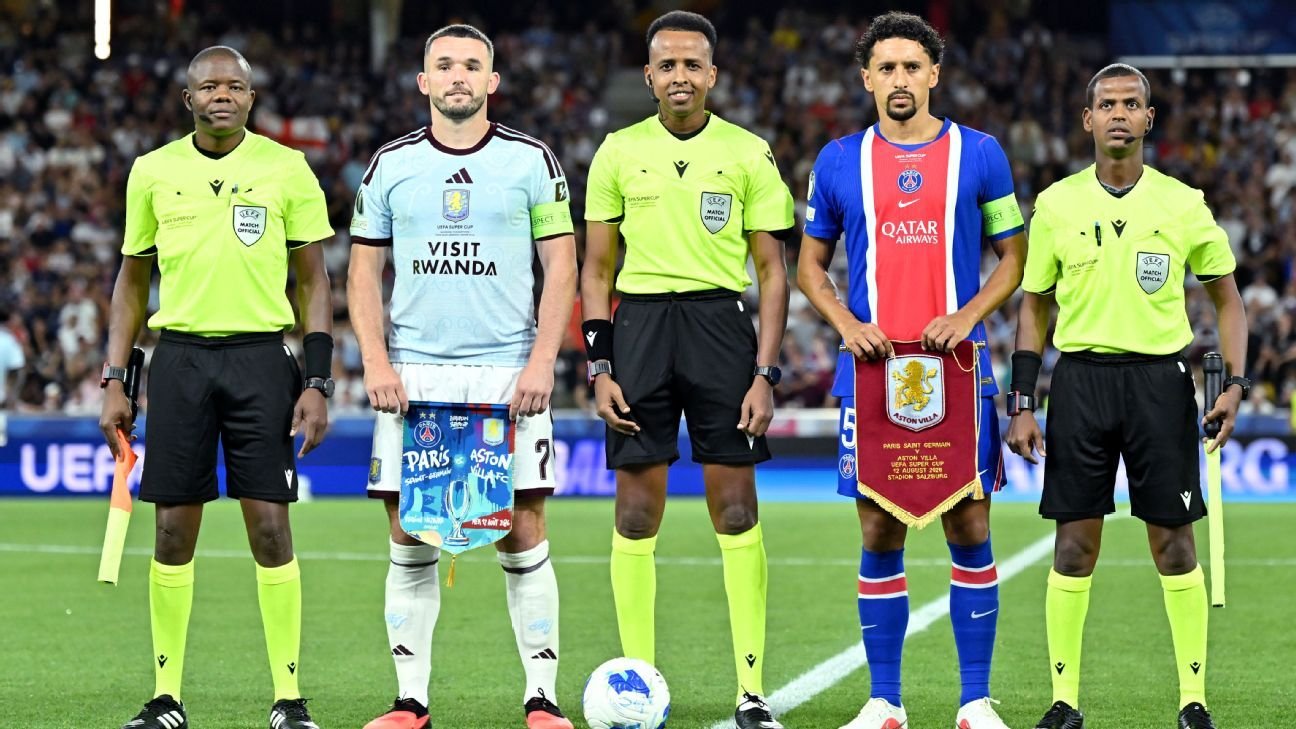
However, what began as a devastating setback led to a series of remarkable events, ultimately allowing him to take charge of the opening match for Europe’s top clubs. In the spotlight at Red Bull Arena in Salzburg on Wednesday, Artan officiated the UEFA Super Cup between defending Champions League champions Paris Saint-Germain and the Europa League winners Aston Villa.
Artan played a pivotal role in the match by allowing play to flow when PSG’s Désiré Doué scored the eventual winning goal. “It’s fantastic that he was able to officiate such a significant match,” Doué remarked to ESPN afterward, adding, “I’m genuinely happy for him.”
Rapid Rise
Omar Artan never intended to become a referee. Once a hopeful player, his aspirations were dashed by a leg injury. It was during a local match that the opportunity to officiate arose when both teams requested his help. He has officiated ever since.
The ongoing civil war in Somalia posed significant challenges for Artan’s nascent refereeing career. “There were times on the way to training where explosions forced me to change routes to reach the stadium,” he reflected in an interview with Al Jazeera prior to the World Cup.
Determined, Artan rose through the ranks to referee Somalia’s First Division and earned FIFA certification in 2018 while still in his mid-20s, heralding his entry onto the international scene, where he became known as a competent and respectable official.
“He knows how to maintain his focus and not steal the spotlight, which is a trait many referees lack,” said Somali football journalist Mohamed Salad to ESPN. “Effective refereeing involves more than right or wrong calls; it’s about managing the game, and Omar excels at that.”
In 2024, Artan achieved a historic milestone by becoming the first Somali to officiate at the Africa Cup of Nations (AFCON) held in Ivory Coast. His accomplishment generated immense support from a nation that has yet to qualify for a major tournament and last hosted an international match in 1988—many Somalis tuned in to watch Artan’s officiating.
“Having one of our own officiate at such a prestigious international level was a moment of national pride in Somalia, second only to Abdi Bile winning World Championship gold in 1987,” Salad noted. “His first match featured Namibia versus Tunisia—not a game many outside those nations would have watched. However, thousands of Somalis tuned in to witness how Omar managed the pressure.”
His AFCON debut was succeeded by being awarded the African Football Confederation’s (CAF) Referee of the Year in November 2025, and shortly after, he received a nomination to officiate at the World Cup following a rigorous three-year assessment by the FIFA Referees Committee led by Pierluigi Collina.
With his World Cup opportunity confirmed, Artan officiated the second leg of the 2025-26 CAF Champions League final between South Africa’s Mamelodi Sundowns and Morocco’s AS FAR. Shortly thereafter, he embarked on his journey to the U.S.
International Outcry
Following a lengthy interrogation and hours spent in a holding cell in Miami, Artan was placed on a flight back to Istanbul, retracing the last leg of his journey to the United States—with no explanation provided initially. As news of the incident spread globally and sparked outrage, Andrew Giuliani, head of the White House Task Force on the 2026 FIFA World Cup, defended the decision, citing alleged unproven connections to terrorism.
FIFA later confirmed Artan’s inability to officiate in the tournament, stating, “FIFA can confirm that match official Omar Abdulkadir Artan will be unable to train and officiate at the FIFA World Cup 2026 after he was denied entry into the United States.” Given that FIFA’s referee base camp was located in Miami, officiating in the co-host nations Canada and Mexico was not an option. Somalia’s Ministry of Sports expressed profound disappointment over the treatment of Artan.
Artan returned home to a hero’s welcome on June 10, 2026. He was met by members of the Somali Football Federation, government officials, and supporters at the airport, who greeted him with flowers and Somali flags. Later, thousands filled Mogadishu Stadium, where he was lifted by fans and paraded around before attending a local league match as an honored guest.
On the following day, CAF and UEFA announced that Artan would officiate the UEFA Super Cup, marking the historic occasion of becoming the first non-European referee to preside over a major UEFA final. The match officiating team also comprised two officials from CAF: Liban Ahmed from Djibouti and Stephen Yiembe from Kenya.
Artan’s appointment was not limited to Europe; eleven days after returning to Somalia, the Kuwait Football Association invited him to officiate the final of the 2025-26 Premier League season. Furthermore, at the start of August, he oversaw the CECAFA Kagame Cup final—an annual competition for Central and East African club teams held in Rwanda—before heading to Europe.
#SuperCup referee Omar Artan has touched down in Salzburg 🇸🇴🛬🇦🇹 pic.twitter.com/t4mwbPwFEZ
— UEFA (@UEFA) August 10, 2026
Making History
The welcome at Salzburg Airport on August 11 may have been more subdued than the exuberant crowd in Mogadishu, yet a group of Somalis still gathered to take pictures with the newly recognized figure upon his arrival. Support continued at the stadium during the match, where CAF President Patrice Motsepe joined UEFA President Alexander Čeferin while Somali flags waved in the stands.
The official match program included a feature on Artan aptly titled “Don’t Stop Dreaming.” In this piece, Artan expressed to UEFA: “If you want to be a referee, it’s the best decision you can make. Pursue it without hesitation, regardless of the obstacles others place in your path.” The moment was set for something special.
Artan’s European debut started smoothly, with Khvicha Kvaratskhelia scoring first for PSG, followed by a reply from Aston Villa’s Brian Madjo in an otherwise quiet first half. However, the match intensified in the second half, and Artan rose to the challenge, maintaining composure throughout.
✅ History made!
Omar Artan is officially the first non-European to take charge of the UEFA #SuperCup! pic.twitter.com/IWdVEDaSsb
— UEFA (@UEFA) August 12, 2026
Artan issued yellow cards to Aston Villa players Pau Torres, João Gomes, and John McGinn, which drew protests from the bench. Yet, Aston Villa coach Unai Emery later expressed his understanding, saying, “I recognize and respect UEFA’s efforts to develop referees from various countries.”
Artan also made the correct call by allowing play to continue when PSG’s Doué scored after cutting in from the right. Initially flagged for offside by his assistant, the VAR review confirmed the goal, sealing a 2-1 win for the European champions and marking their second consecutive Super Cup title, making them only the third club in history to achieve this.
Doué, named Player of the Match, praised Artan immediately after the game, stating, “I want to congratulate him for being able to officiate such a significant match. It’s a big honor, and I hope he becomes a referee for many more major competitions. I’m truly happy for him.”
After the final whistle, Artan inscribed a message on a match ball and gifted it to UEFA, reading: “Thank you, UEFA. You’ve truly changed my life. This was my World Cup.”
Looking ahead, whether Artan will realize his dream of officiating at the World Cup in 2030 is uncertain. The number of referees selected for such prestigious tournaments is limited, and remaining at the pinnacle of officiating is a considerable challenge—as evidenced in 2022 when only Algeria’s Mustapha Ghorbal represented African referees in Qatar. Much will depend on his performance and fitness leading up to the next World Cup.
Nonetheless, after a transformative summer, Artan’s profile has significantly risen, equipped with elite-level experience from various continents. He remains hopeful about one day making the World Cup a reality. And he will never cease dreaming.