



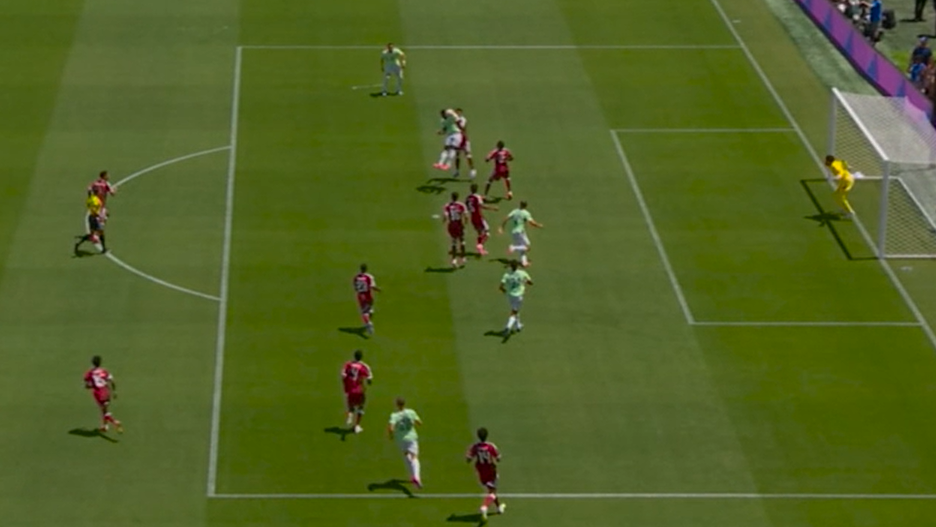
The incident involving Switzerland‘s Remo Freuler was deemed offside just before he was fouled by Qatar’s goalkeeper, Mahmoud Abunada. This has left many questioning whether the call was correct, especially as FIFA only shared images related to the incident four and a half hours later.
That play led to a penalty, successfully converted by Breel Embolo, resulting in a 1-1 draw during Saturday’s World Cup Group B match in Santa Clara.
Prior to the tournament, FIFA expressed confidence in its enhanced semi-automated offside technology, stating that it had scanned every player at the World Cup to create realistic avatars aimed at delivering precise offside illustrations. However, when this technology failed, FIFA resorted to using traditional methods of drawing lines on the field.
In an official statement, FIFA explained that a technical glitch prevented the onside animation graphic from being displayed. They assured that the VAR’s checks did not show any offside and released two images that failed to convince critics, avoiding the usual avatar graphics.
During the play, two players from Switzerland could potentially have been offside, and FIFA shared images claiming both were onside: one for Embolo during the build-up and another for Freuler before he was fouled.
FIFA’s statement highlighted that “the VAR’s workflow remained unaffected and adhered to the standard checking procedures for the on-field decision,” asserting that the lines used for the VAR check indicated neither relevant player was offside prior to the penalty.
However, the semi-automated technology is not infallible; its accuracy can be compromised by factors like players being closely positioned or even by foreign objects, like ticker tape, on the pitch. In the Premier League, if this technology encounters failures, VAR can revert to drawing lines, although the offside image would typically be generated promptly rather than hours later.
As Gary Neville pointed out on ITV prior to the statement, “We all think [it was offside]. Everyone watching at home thinks it’s offside too. There’s a significant question here because until proven otherwise, it appears to be offside.”
The lengthy delay in revealing the evidence has fostered skepticism and conspiracy theories, giving the impression that FIFA may be concealing something.

This image was released by FIFA as evidence, but they did not provide the avatar graphics [FIFA]
‘Prove to us that it’s offside’
“The situation resembles a dictatorship,” continued Neville. “To withhold this evidence from fans, especially during an important tournament, is completely unreasonable. We need transparency—if you believe it was offside, show us the evidence immediately.”
FIFA had previously showcased the use of avatar animations for both contentious and clear decisions during matches. For instance, on Friday, Tani Oluwaseyi was flagged offside before a foul was committed by Nikola Vasilj on a Canadian striker, with FIFA providing the semi-automated graphic even though VAR was not involved.
FIFA has generally been swift in delivering offside decisions at this tournament, utilizing an audio alert system that notifies assistants when a player is offside by more than 10cm, eliminating the need for delayed flags. While this technology leads to faster decision-making for clear calls, the situation involving Freuler was a marginal one that fell just under the 10cm threshold.