




-

Sam Tighe
Multiple Authors
Football clubs worldwide, regardless of their size, heavily invest in player recruitment by assembling teams of scouts and analysts. Some larger clubs, like Chelsea, go as far as hiring several sporting directors to compile transfer shortlists for each position year-round.
In contrast, the process for selecting a new manager or head coach is often less structured. These decisions are typically made by a small group of top executives within the club, as seen in the case of Manchester United‘s leadership, where Omar Berrada and Jason Wilcox chose Rúben Amorim to replace Erik ten Hag and are considering giving Michael Carrick the permanent role.
Meanwhile, Real Madrid takes it a step further: While various influential voices are involved in their selection process, the final decision often hinges on what president Florentino Pérez prefers. However, many clubs across different leagues are beginning to incorporate data and analytics into their searching processes, similar to how they assess players.
“Over the past decade, player recruitment has evolved to better integrate data and expert opinion,” says Edward Sulley, Hudl’s Director of Customer Solutions, in an interview with ESPN. “The landscape of head coach and manager recruitment is currently undergoing a similar transformation.”
However, there is a significant challenge: it can be prohibitively expensive. Sulley, who worked for Manchester City for 11 years in performance analysis and other roles, explains the costs: “If you’re hiring data engineers, you might be looking at around $200,000 per person, not to mention the infrastructure, software, and data sources… It quickly adds up to over $2 million annually in operational expenses.”
Some clubs are interested in using analytics for their managerial searches but are deterred by the associated costs. This gap has led to the emergence of several companies offering services to assist clubs in this area. ESPN spoke to three key players in this field—Hudl, Analytics FC, and MRKT Insights—to explore how their work is transforming football.
What is the Process?
The recruitment process begins with a conversation—ideally with clubs strategically looking ahead in case their current manager departs or maintaining a shortlist for potential replacements.
However, in the football world, such foresight is rare.
“Most inquiries stem from situations where clubs have just, or are about to, dismiss their coach and urgently need assistance in finding a replacement,” says Alex Stewart, CEO of Analytics FC.
This often results in a frantic week or two of activity, as clubs struggling at the bottom of the league race to find answers.
“Decision-makers face significant pressure, often from owners who receive input from various sources—agents, acquaintances, and so on,” Sulley adds. “Much of football is still driven by relationships, meaning that whoever can influence the owner’s decisions can have a substantial impact.”
These situations require swift solutions, which is where these companies have established their niches. They utilize data to help clubs determine potential managerial candidates.
Analytics FC and MRKT Insights begin by meeting with club representatives and asking fundamental questions: Do you prefer younger or experienced candidates? Is fluency in a particular language necessary? Should the candidate have experience in specific countries or cultural contexts?
“If it’s good enough for players, why shouldn’t it apply to managers?” — Alex Stewart, CEO of Analytics FC
These initial inquiries may seem elementary, but even the best clubs can overlook such aspects. For instance, Bayern Munich sticks closely to German-speaking coaches, and after hiring Pep Guardiola and Carlo Ancelotti from 2013-2017, they were eager to revert to a more fluent communication style.
As discussions progress, the questions become more nuanced.
“We have a checklist we go through,” says Tim Keech, co-founder of MRKT Insights. “Did they coach the desired style of play? Are they a good personality fit with the ownership? Have they thrived in similar organizational structures, or do they demand full control? Do they need elite-level experience? And so on.”
Hudl conducts similar conversations with select clubs, offering many access to a customizable dashboard. Here, clubs can upload their search criteria through a series of questions and sliding scales, which refine their candidate pool. If further assistance is needed, they can engage with Hudl for additional support in their decision-making.
How is the Approach Customized?
“It’s fascinating to see some clubs contemplating their tactical style in the context of their overall brand identity,” Stewart notes. “They’re beginning to develop a cohesive understanding of their club’s brand and how playing style reflects broader values.”
A prominent example is the Red Bull organization, operating six clubs worldwide, which has consistently demanded a high-pressing, dynamic style that mirrors its energy drink philosophy. Conversely, clubs like Manchester United adopt an attacking style reflective of fan expectations, while others, like Stoke City, excel in an aggressive, physically combative approach.
All these responses enable the creation of search criteria, leading to the formation of a longlist. This can be extensive—up to 50 candidates in some cases, according to Stewart—before narrowing down to a shortlist of 5 to 10 names, as favored by Sulley, although Stewart and Keech often find they still have at least 15 options at this stage. Additional names can be included as needed.
“Often, word gets out that a club might be considering a change, and soon agents are proposing candidates, prompting calls to the Sporting Director to vet potential hires,” Stewart states. “Sometimes, clubs solicit us to justify the rejection of certain candidates—perhaps due to style mismatches or lack of impact—but occasionally, we might advocate for someone who fits their criteria perfectly.”
So how does this work?
“Listen to any manager articulate their desired style, and it often comes down to similar frameworks,” Keech remarks. “They describe formations like 4-3-3, emphasizing possession, midfield rotations, and pressing high—blending elements reminiscent of peak Barcelona and Paris Saint-Germain teams.”
Smiling, Sulley concurs: “Having participated in numerous coaching interviews, especially at Manchester City and Hudl, I can affirm this observation.”
How, then, do you sift through the noise, external influences, and the often exaggerated claims of managerial candidates? The solution may lie in data. Each of these companies applies data differently, but they share the same objective: to provide an objective solution to the issue at hand.
Case Study 1: Analytics FC
Analytics FC engages with various teams in men’s football across England, Scotland, Scandinavia, and Central Europe, as well as international governing bodies. It has also assisted elite women’s teams in both the USA and England.
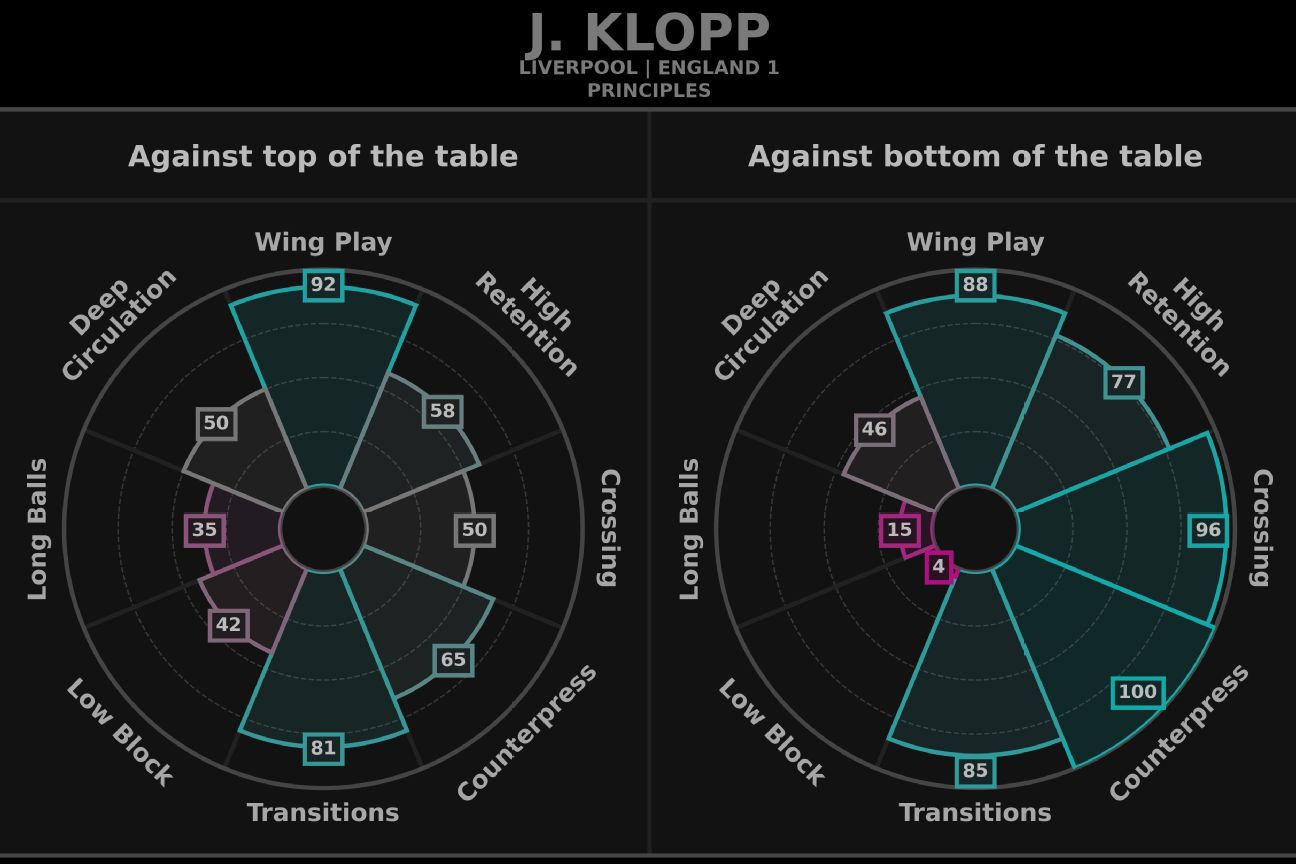
For each managerial candidate, they create a segmented wheel displaying eight key traits, each scored out of 100. Specific statistics support each characteristic.
A high score for deep circulation suggests a manager’s patience in moving the ball through different zones on the pitch, measured by pass volume and duration in the defensive area. Conversely, a low counter-pressing score may indicate a passive defensive strategy, determined by how quickly and intensely teams attempt to regain possession in particular zones.
These scores indicate how frequently teams engage in certain actions, not necessarily their effectiveness, although metrics like “High Retention,” which captures successful possession in the opponent’s half, do indicate quality.
Importantly, manager profiles are divided into two segments: performance against top opponents and against weaker teams, a differentiation that has proven beneficial for many of Analytics FC’s clients.
“If you need to adopt a counterattacking style against stronger squads while dominating possession against everyone else, we can craft a coach profile to reflect that,” explains Stewart.
This could apply to a mid-table Scottish team striving to outperform Celtic and Rangers, or to Croatian champions Dinamo Zagreb, who dominate their league but frequently face tougher competition in European matches.
Case Study 2: Hudl
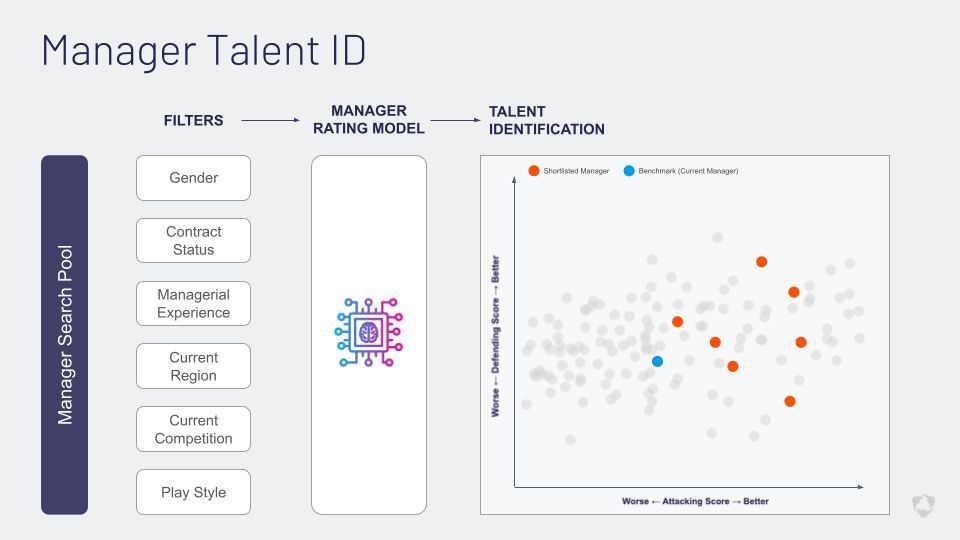
Hudl’s dashboard processes the criteria clubs input, analyzing thousands of active managers and identifying the best matches. Coaches receive defensive and attacking scores derived from specialized metrics.
Some metrics are unique to Hudl, such as their HOPS (Header Oriented Performance System), which evaluates a player’s ability to win aerial duels while accounting for the identities of the players involved. For example, if 5-foot-7 Lionel Messi outjumps 6-foot-5 Virgil van Dijk, he’d receive due credit.
They also incorporate OBV (On Ball Value), which quantifies players’ contributions to positive actions, such as goal creation. Hudl evaluates several other metrics—including Expected Goals (xG), chances created, and passing accuracy—to build comprehensive manager profiles. This dashboard can assess the impact a candidate has had on these metrics and adjust for team and opponent quality, presenting the data in radar format.
Clubs can meticulously adjust their search parameters within the dashboard to pinpoint ideal candidates. Alternatively, if their criteria are vague, they can use a reference manager, perhaps Pep Guardiola, and search for coaches who exhibit similar styles.
A broad spectrum of clubs and nations, from lower-tier teams to mid-level Premier League clubs, utilize this dashboard to inform decision-making. Emerging nations employ it to identify hidden talents, while top-tier clubs use it to consistently monitor their own managerial talent pool.
Case Study 3: MRKT Insights
MRKT Insights primarily operates within the English Championship and Football League, but has also consulted for Champions League clubs and teams in the Premier League and Serie A. At face value, the manager profiles they produce are simpler.
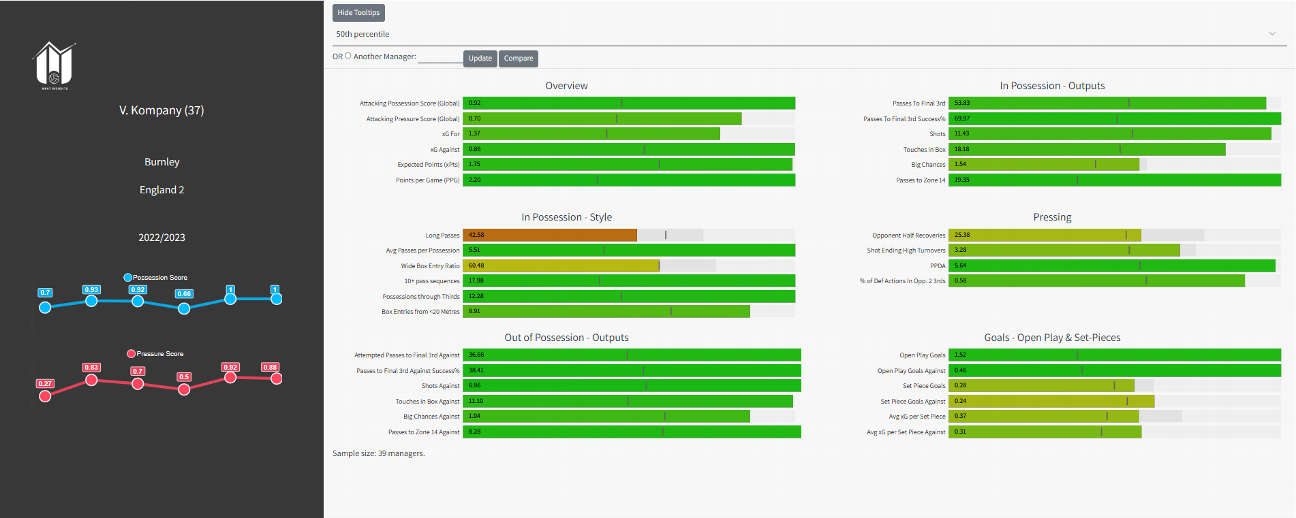
“We categorize managers based on two key metrics: attacking pressure and attacking possession,” Keech explains. “The most effective managers excel at both.”
MRKT Insights assigns every manager a score from 1 to 100 based on these principles. Delving deeper into these scores reveals a complex array of statistics.
“For the attacking possession score, we measure pass sequence lengths and possessions through the thirds (where possessions start and finish). If a manager gets high marks for attacking pressure, they are actively creating more opportunities in the opponent’s box and generating high turnovers, thereby keeping play focused near their opponents’ goal. ‘Field tilt’ measures the ratio of touches in the final third, an intriguing metric.”
A vast amount of data undergoes analysis, resulting in two scores for each manager in the system. Keech notes that his team identifies the statistics most linked to future success, highlighting particular metrics that can substantially enhance a manager’s score, such as successful cutbacks and through balls.

1:04
How Vincent Kompany has ‘reinforced’ Bayern Munich’s identity
Ale Moreno discusses Vincent Kompany’s impact on Bayern Munich after beating Köln and matching Pep Guardiola’s Bundesliga record.
Identifying Effective Coaches in Challenging Scenarios
Determining a manager’s true impact can be challenging, as metrics like trophies won, league standings, and points per game often offer only partial insights and can sometimes mislead.
“When we established our service, the only reliable method to identify managers was to visit Transfermarkt, seek out unemployed coaches, and filter them by points per match,” Stewart reflects. “We found this method lacking since points per match mainly highlights those coaching the richest or most successful clubs. Hence, we developed a model to identify managers who genuinely add value, even if their teams aren’t performing well.”
This value can manifest in diverse forms, often seen as an uptick in underlying metrics before and after a manager’s appointment.
“We observe coaches elevating a team’s standing from, for instance, the 20th percentile to the 50th percentile,” Keech mentions. “Take David Moyes, for example; he consistently proves adept at making teams better without necessarily achieving dominance.”
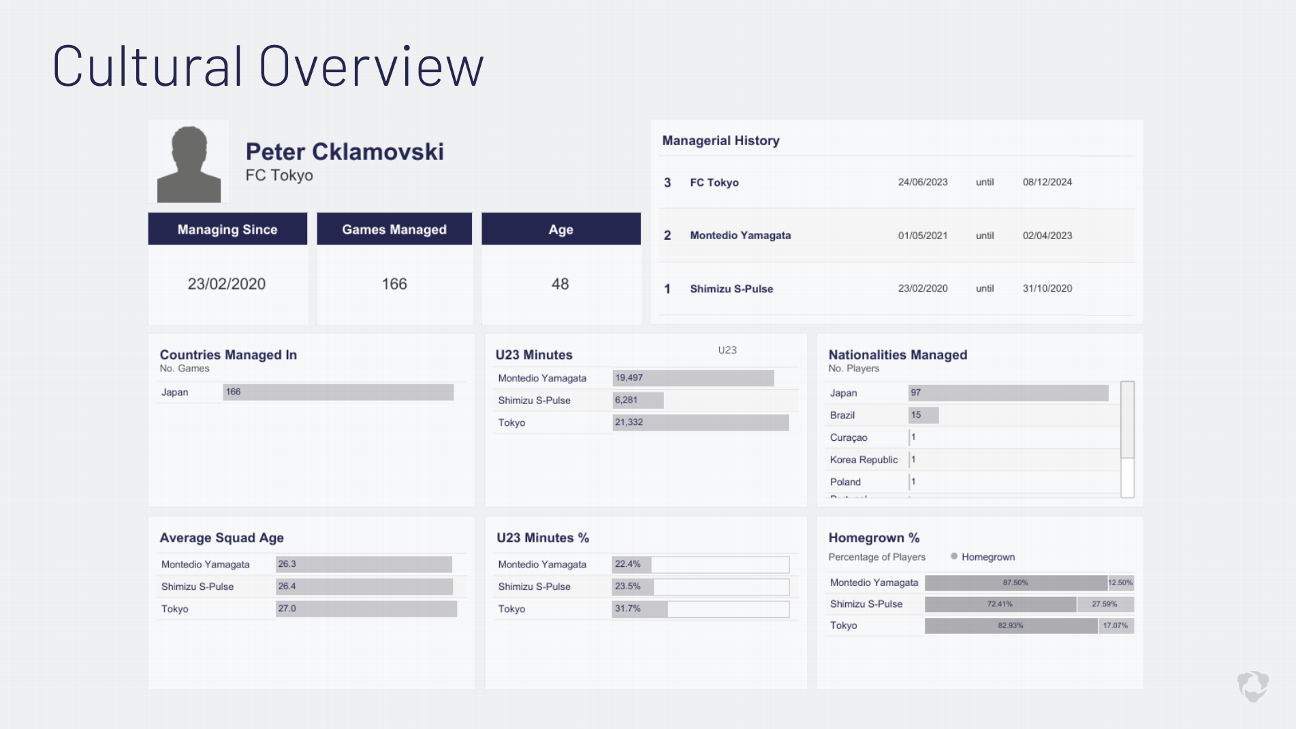
Hudl’s reports can trace a manager’s influence over several years and across multiple teams. Pictured is Peter Cklamovski, whose coaching in Japan and now the Malaysia national team demonstrated a generally positive impact.
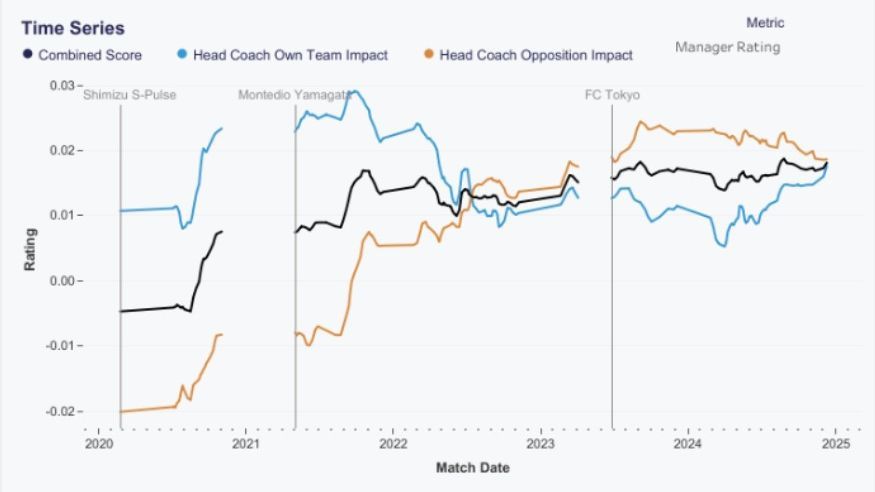
Managers can also be assessed through player market valuation changes, reflecting improvement. Analytics FC tracks a metric for effective substitutions as well. In cases where managers oversee relegation while adhering to an unsuitable style, their records may reflect failure, yet the data may present a more nuanced picture.
“Vincent Kompany serves as a prime example,” Stewart explains. “He led Burnley to a Premier League promotion in 2022-23 with a squad that performed well relative to the Championship, playing attractive football. Unfortunately, due to various factors, he couldn’t adapt his playing style for success in the Premier League.”
Despite relegation, Kompany’s team excelled on key metrics identified by MRKT Insights, showcasing possession-based football and effective offensive zone entries.
For elite clubs, they’re in search of dominance in style along with distinct skills beyond excellent coaching, such as media presentation and stress management abilities. Having captained Manchester City to four Premier League titles, multilingual Kompany carries clout, perceived as a winner among his peers and having faced media scrutiny for two decades.
His hiring as Bayern Munich manager in 2024, following a relegation with Burnley, surprised many, as he wasn’t the first, second, or even third choice. Yet, it didn’t surprise those who have adapted to modern approaches for navigating managerial appointments.