



Referee Darren England experienced an unusual weekend.
On Saturday, in his debut Premier League match as the video assistant referee (VAR), Farai Hallam rejected England’s advice and opted not to award a penalty to Manchester City for a handball.
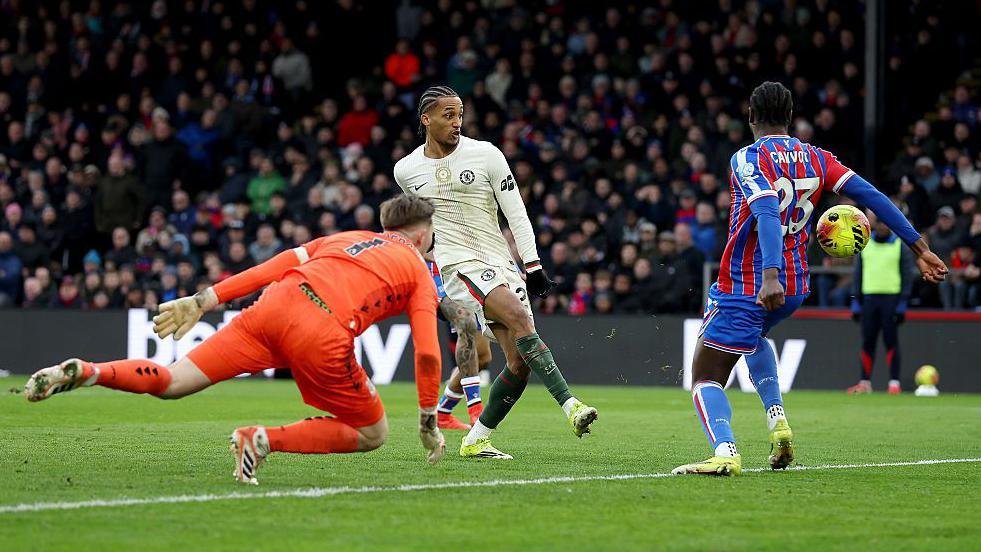
On Sunday, the roles were reversed as England officiated Chelsea’s 3-1 victory over Crystal Palace. In this instance, he was called to the pitchside monitor to assess a possible handball that could lead to a penalty.
Palace defender Jaydee Canvot had blocked a shot from Joao Pedro with his arm, which was positioned naturally at his side.
England reviewed the video for nearly two minutes, reportedly needing considerable persuasion.
The VAR, Matt Donohue, who has limited experience with only four top-flight matches under his belt, insisted that a penalty was warranted because the arm had interfered with a potential goal. Eventually, England agreed and awarded the penalty.
The International Football Association Board (IFAB) has previously clarified that in such situations, a penalty is not automatically granted.
On its Football Rules website, the board poses the question: “If a player stops the ball from entering their own goal with their hand/arm, but does not deliberately handle the ball or expand their body unnaturally, is it a penalty?”
The response is: “This is not a handball.”
Much of the confusion stems from a rule change in 2024, where IFAB amended the language regarding denying an obvious goalscoring opportunity (DOGSO).
The revised text states: “When a player denies an opposing team a goal or an obvious goalscoring opportunity through a non-deliberate handball offense and the referee awards a penalty kick, the player will receive a caution.”
The crucial aspect is that it must be deemed an “offense” — in other words, making the body unnaturally larger.
It’s been misconstrued that all handballs preventing a goal result in a penalty and a yellow card. The law change only modified the consequence from a red card to a yellow card.
First, there must be a handball offense, and then the evaluation of DOGSO takes place.
This update was intended to align handball offenses with foul challenges and double jeopardy principles.
Thus, a genuine attempt to play the ball, or a non-deliberate handball where the body is enlarged, results in a caution.

Chelsea converted their penalty after Jaydee Canvot was penalized for handball [Getty Images]
Indeed, the standard for arm positioning is stricter when the ball heads towards the goal.
For example, consider the handball incident involving Wolves defender Yerson Mosquera during his team’s 2-0 defeat at Manchester City. While Hallam dismissed the handball review, had the defender been on the goalline with his arm away from his body, a penalty would likely have been awarded.
In Canvot’s case, he had his arm close to his side and the ball deflected off his hip.
This situation would typically not be viewed as a handball offense in other contexts. The Premier League’s Key Match Incidents (KMI) panel is expected to assess this as an error.
It’s illogical that a different ruling would apply if Canvot were merely three yards to his right or if there had been a teammate or goalkeeper behind him.
“It’s not that complicated,” said Danny Murphy on Match of the Day. “Canvot’s arm is positioned naturally alongside him. I don’t understand why VAR even intervened, resulting in the wrong decision.”
Former Premier League official Darren Cann echoed this opinion, stating, “To me, it wasn’t a penalty, as Canvot neither deliberately handled the ball nor had his arm in an unnatural position.”
Wayne Rooney remarked on the growing frustration among fans regarding VAR errors.
In November, a similar situation occurred with Newcastle’s Harvey Barnes, who stood on the goalline while defending a corner. The delivery curved into the goal area and hit his arm, which was next to his body. No VAR intervention was made, and the KMI panel unanimously agreed with that decision.
This marks the second instance this season where Crystal Palace has faced controversy over VAR decisions in matches against Chelsea. In August, Eberechi Eze’s goal was disallowed after VAR determined that Marc Guehi was too close to the wall during a free-kick, an unprecedented reason for disallowing a goal in the Premier League.
Why Maguire did not concede a penalty at Arsenal
Arsenal was down 2-1 against Manchester United in the 71st minute at the Emirates Stadium when they appealed for a handball penalty against Harry Maguire.
There is a provision excluding handball when a player uses their arm to support their body as they fall.
This holds true even if the arm is not on the ground and lands atop the ball.
Maguire was already falling with his arm extended when Mikel Merino’s shot struck his hand.
This exemption, however, is not absolute. A defender could be seen as deliberately placing their arm in the ball’s path.
There have been two instances of players incorrectly avoiding penalties in such situations. In February 2023, Tomas Soucek for West Ham faced a no-penalty decision against Chelsea, and Martin Odegaard should have conceded a spot-kick for Arsenal against Liverpool in December 2023.
In both cases, the players made intentional moves to block the ball, unlike Maguire’s actions.