



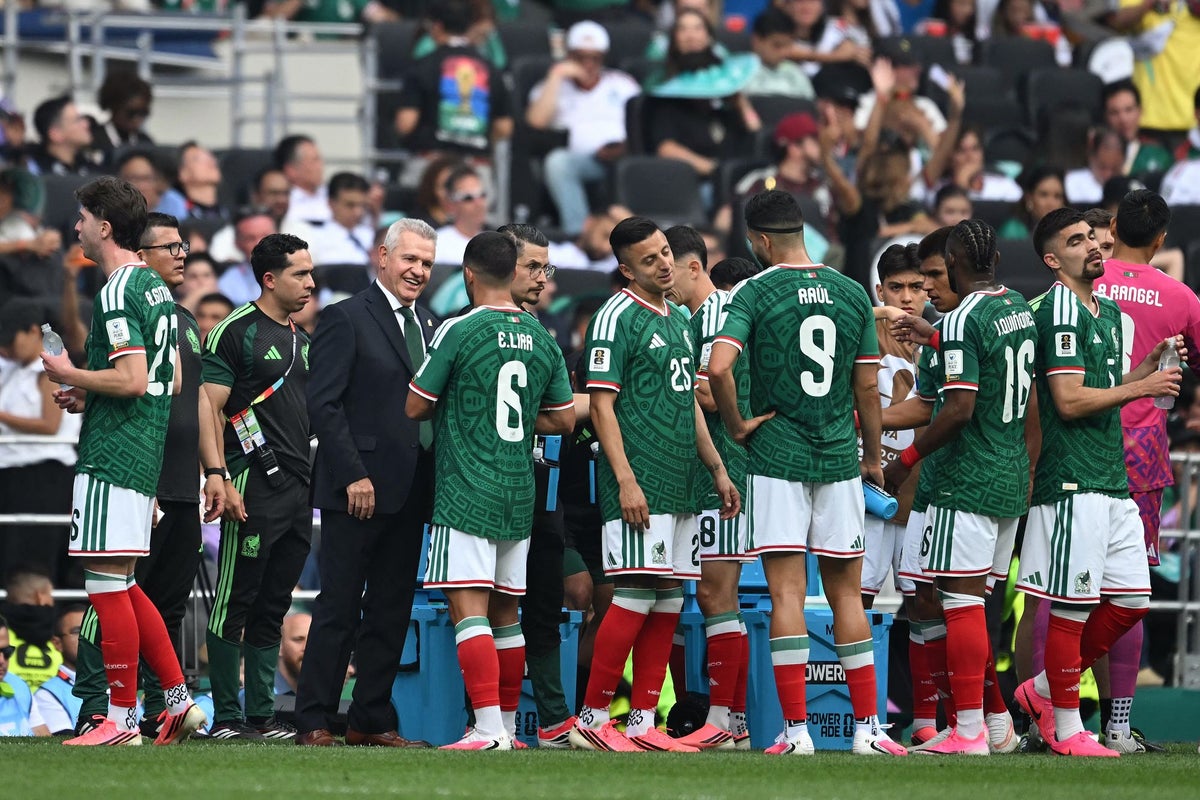
“This hydration break is powered by Powerade,” thundered Fox Sports commentator Ian Darke, as the action paused at the tournament’s inaugural match after 24 minutes to allow players a moment to hydrate. The temperature in Mexico City was a pleasant 23°C, a welcome relief for summer in Mexico. However, recent weeks have shown us that this is an opportunity not to miss when it comes to making money.
Of course, Fox Sports seized the three-minute pause to air enticing advertisements. Powerade, the official sports drink of FIFA, took the spotlight briefly before transitioning to commercials for AT&T (telecommunications), Michelob Ultra (light beer), Lowe’s (home improvement), and FanDuel (sports betting). As the break concluded, the broadcast returned to a scene of players getting ready to resume play. The time taken for a three-minute water break remains unclear.

Mexico’s head coach Javier Aguirre talks with his players during the hydration break (AFP/Getty)
This unexpected break dampened the energy of what had been an exciting opening match. Inside the stadium, the cheers that accompanied the Mexican national anthem and their first goal faded into the background as music filled the air. Spectators gradually left their seats, likely in search of food and beverages, while the big screens displayed “dance cam.”
Advertisement
There will undoubtedly be instances where hydration breaks are warranted during this World Cup. However, FIFA’s decision to implement mandatory water breaks for all 104 matches marks a historic, unprecedented move. FIFA claims these stoppages will “ensure optimal conditions for players,” though a more skeptical viewpoint suggests that broadcasting partners are eager to enhance their profits during a crucial tournament.
“I’m not in favor of it,” commented U.S. coach Mauricio Pochettino when discussing the potential for water breaks in America’s upcoming match against Paraguay. “I only support them during extreme conditions. When the weather is good, they seem unnecessary.”
“I hate it,” tweeted Carli Lloyd, celebrated U.S. women’s player.
What made the situation even more surreal was that this strange occurrence took place in the iconic Estadio Azteca, a revered venue in football history. It is where Pelé claimed victory in the 1970 World Cup and where Diego Maradona executed his legendary “Hand of God” goal—moments etched in the sport’s lore.

Before the match began, ITV Sport’s Ally McCoist stood on the touchline, visibly emotional to be at such a historic event. Ironically, the stadium has been rebranded for the tournament as the impostor “Mexico City Stadium” to comply with FIFA’s naming policies. Given the tournament’s focus on profit, one would have expected a sponsorship title like The Coca-Cola Stadium or The Hyundai-Kia Arena instead.
Advertisement
It’s worth mentioning that FIFA had already catered to Fox Sports prior to the start of the tournament. Fox threatened legal action against FIFA for relocating the Qatar World Cup from summer to winter. To circumvent a messy and costly lawsuit, FIFA agreed to a reduced contract for the 2026 World Cup, allowing Fox Sports to acquire rights for $500 million in 2015. This fortunate deal allowed Fox to host the tournament on home ground in North America, expanding to 48 teams and 104 matches. Broadcast rights are now valued at an estimated $1.5 billion, getting secured for a fraction of that price.
Thus, FIFA’s decision to segment every match into quarters yields further advantages for Fox Sports. With the potential for 208 advertising breaks, Michael Johnson, an analyst for S&P Global, noted that each commercial slot could command Super Bowl-level prices, ranging from $7 million to $9 million. As discussions for water breaks persist for the 2030 World Cup, expected to take place in the warmer climates of Morocco, Spain, and Portugal, competition among broadcasters and streaming services is anticipated to be highly profitable for FIFA.
The traditional structure of football, arguably the world’s most beloved sport, has been dramatically altered overnight on its grandest stage. Coaches are now employing these breaks as tactical timeouts, as both were observed giving instructions to their players despite their need to hydrate. While American fans may be used to similar intermissions, they are being deprived of the very pace that makes football thrilling.
Is this shift truly necessary? FIFA president Gianni Infantino has declared the financial success of this World Cup, with revenues projected to surpass £10 billion for the first time. Is there a genuine need to pursue even greater profits? Water breaks come at a significant cost to the game’s essence. Unfortunately, FIFA continues to serve one master—money.