



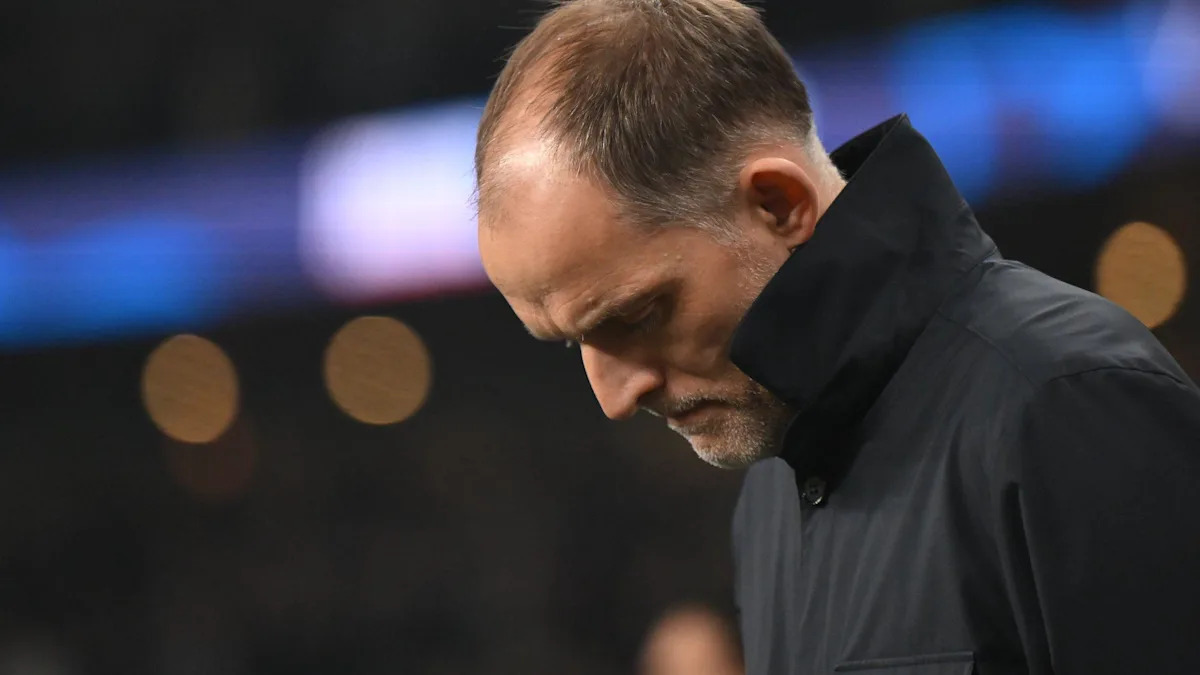
With just 80 days remaining until England kicks off their World Cup journey against Croatia in Texas, this international break is perceived as a crucial last chance for players to secure their spot in the squad.
This window serves as a final opportunity to shape a competitive team for the upcoming tournament and allows players a chance to win Thomas Tuchel’s favor.
Advertisement
Tuchel’s strategy for this international window has been unconventional, as he has announced an expanded 35-man squad divided into two camps for the two fixtures.
The first camp primarily features fringe players, including returning stars Harry Maguire and Phil Foden alongside newcomers James Garner and James Trafford in Friday’s lackluster 1-1 draw against Uruguay.
Captain Harry Kane will lead a group of 11 players for the upcoming match against Japan, featuring Tuchel’s most reliable choices, including Morgan Rogers, Marc Guehi, and Elliot Anderson.
Will Tuchel be satisfied with the performances to date, or might he regret his unconventional squad strategy?
Advertisement
‘I’m not convinced we’ve gained new insights’
Tuchel took on the role of England manager in October 2024 and officially began on January 1, 2025.
Yet, despite securing an early contract extension, he has led the team in only 11 matches.
For context, Roy Hodgson played his first 11 games in just 169 days after his appointment. In contrast, it has taken Tuchel 609 days to reach the same milestone.
England comfortably topped Group K during qualifying, winning all eight matches, scoring 22 goals, and conceding none.
However, their group opponents were ranked outside the world’s top 20: Albania, Andorra, Latvia, and Serbia.
Advertisement
England’s toughest match last year, based on ranking, was a friendly against Senegal, then ranked 19th, where England lost 3-1.
When the matches against Uruguay and Japan were announced, Tuchel expressed his intention to face two teams ranked within the world’s top 20 to assess how England might measure up against non-European competition.
So, do we now have a clearer picture of how the Three Lions will perform against stronger opponents this summer?
“We anticipated mixed performances due to the numerous changes,” said former England goalkeeper Paul Robinson on BBC Radio 5 Live. “I’m not sure we’ve gained any new understanding of the team as a collective.”
Advertisement
“We weren’t evaluating England as a unit. The performance was not one to assess as a team—it was aimed at individuals.”
According to BBC senior football correspondent Sami Mokbel, “While I wouldn’t say it was a pointless exercise, I’m not confident Tuchel walked away from Wembley with much new knowledge.”
“That’s the challenge with this type of audition; players tend to focus more on impressing the manager than playing their usual game.”
‘They appeared to be a group of trialists… it was hard to ignore’
Robinson highlighted a significant issue faced by Tuchel and the squad: Friday’s match resembled more of a trial than a true evaluation for “cohesion” and “team performance.”
Advertisement
“Watching the game, it was clear that individuals were overextending themselves,” Robinson stated. “They resembled a group of trialists eager to impress a coach to secure their place beyond that trial.
“The performance felt driven by self-interest rather than that of the team. It was challenging to watch at times.
“Tuchel fostered this atmosphere by opting for a 35-man squad.”
“You can’t disguise it any other way; Thomas Tuchel can claim he’s observing all these players and that it’s about team cohesion, but that’s just not what it was. It was an individual trial game.”
Advertisement
Nevertheless, Tuchel asserted that he had “learned a great deal” from the draw.
“You can identify lessons in the details,” he added. “You observe behaviors and see the levels. I’m glad we approached it this way.”
A revised 27-man squad is now preparing for Tuesday’s match against Japan at Wembley, with eight players set to depart the camp.
John Stones will return to Manchester City due to an issue developed during training, while Arsenal players Noni Madueke, Declan Rice, and Bukayo Saka have also gone back for medical assessments.
Adam Wharton, Aaron Ramsdale, Fikayo Tomori, and Dominic Calvert-Lewin are the others leaving the camp.
Advertisement
After the match against Japan, England will play two more friendlies against New Zealand on June 6 and Costa Rica on June 10.
The World Cup begins just a day later.
‘This was still a valuable exercise’
Tuchel must finalize his squad by Saturday, May 30, meaning he has only one more game to determine who will travel to the United States, Canada, and Mexico.
It makes sense that he would want to observe as many players as possible up close, right?
“This was still a very valuable exercise for Tuchel, and he was justified in giving so many of England’s fringe players game time,” stated BBC chief football writer Phil McNulty.
Advertisement
“With many of his starters more or less confirmed, it was reasonable for him to evaluate those he is still considering against a Uruguay side under Marcelo Bielsa that never takes friendlies lightly.
“Maguire demonstrated his value and experience in defense, while Everton’s Garner appeared comfortable on the England stage—although whether he did enough to secure a World Cup spot remains to be seen.
“Tuchel has a crucial decision to make regarding Harry Kane’s understudy, so it was understandable for him to assess both Dominic Solanke from Tottenham and Leeds’ Dominic Calvert-Lewin.”
“As for the friendly against Japan, expect to see many of England’s starting players return—but Tuchel could hardly be blamed if he wanted to reassess some players who still need to demonstrate their value for a place in his World Cup squad.”
Advertisement
‘The focus is on keeping the core group fresh’
In announcing his 35-man squad, Tuchel underscored the importance of maintaining player freshness.
Following the knockout of four out of six Premier League teams in the Champions League last-16 stage within 24 hours, discussions arose about the demanding schedules players have faced.
Chelsea coach Liam Rosenior remarked that his team was exhausted, having played “over 100 matches in 18 months without a break,” while Manchester City’s Pep Guardiola has frequently criticized the schedule, describing it as a “disaster” for players.
Advertisement
Liverpool’s Arne Slot articulated that England’s absence of a winter break “isn’t beneficial.” In contrast, the French, German, and Spanish leagues enjoy winter breaks of 10 to 17 days.
“These players have logged 3,500 to 4,000 minutes; it’s worth noting that some have already exceeded their total minutes from last season,” Tuchel stated regarding his England players. “The total number of minutes is secondary; what matters is that some of these guys have played more minutes than the whole of last season.
“All players have contributed significantly in September, October, and November. They have earned my trust. Giving them a mental and physical break will benefit us all.”
United States women’s head coach Emma Hayes concurred.
Advertisement
“He knows what he’s doing,” the former Chelsea manager told ITV. “Ultimately, keeping the core group fresh is what matters most.”