



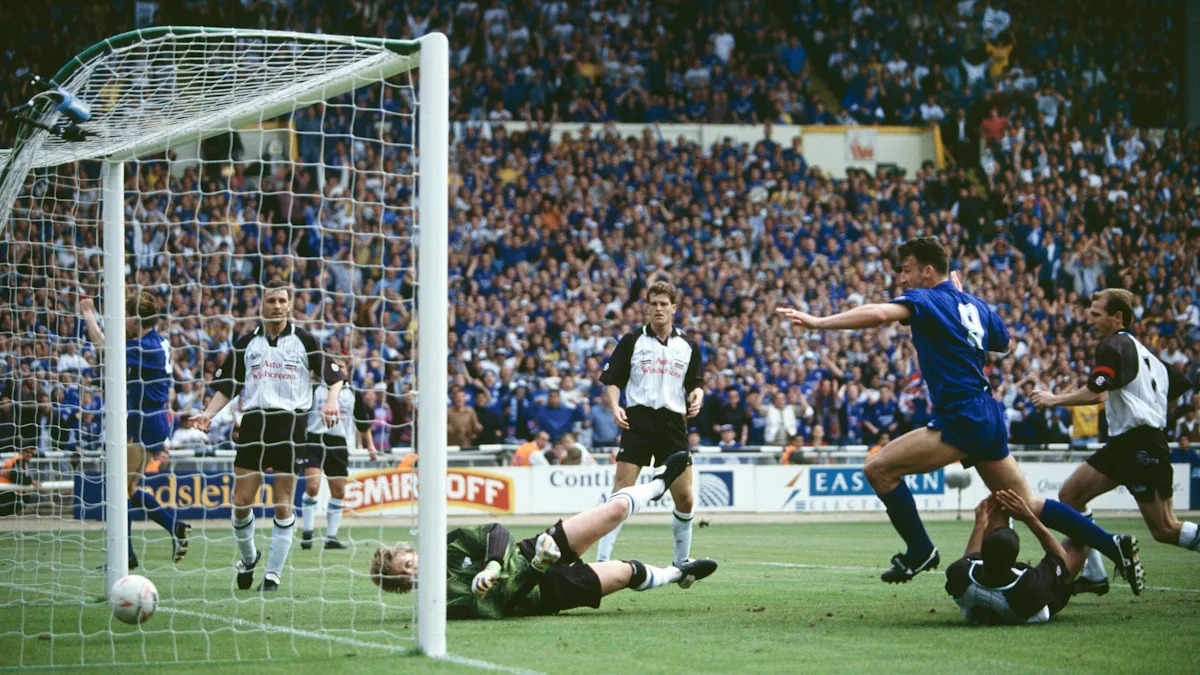
I’ve always found it hard to define Leicester’s significance to us. They aren’t rivals in the same way Forest is – they hold a different kind of resonance, tied to a memory that has lingered in me.
It goes back to a single day: Wembley, 1994, during the First Division play-off final.
Advertisement
I was just 15 then, and that age is crucial; everything hits harder when you’re that young.
Before that day, Leicester meant little to me. Just another team we faced. We played them at the Baseball Ground, but they barely registered on my radar until that fateful afternoon.
Derby had a fantastic squad that season. Lionel Pickering was splashing cash, and Arthur Cox was building something special until his back gave out. Roy McFarland came in, and Derby somehow kept the momentum going.
It was an outrageous season: we scored and conceded so many goals. But in the second half, Derby became truly irresistible. With players like Paul Kitson, Tommy Johnson, Mark Pembridge, Marco Gabbiadini, and Paul Simpson, goals came from everywhere. It felt like something monumental was on the horizon.
Advertisement
The Premier League was new, shining, and full of promise, and I desperately wanted Derby to be part of it. I needed it.
Then came Wembley. My second visit with Derby; the first, the Anglo-Italian Cup, hardly counted — it was a half-empty stadium, a bit of a novelty. But this was different. A scorching day, electric atmosphere – everything pointed toward a Derby victory.
When Tommy Johnson scored, I honestly thought, “This is it. Derby are going up.”
But then, something happened that still haunts me.
A ball came into the box, Martin Taylor was smashed – absolutely wiped out – and referee Roger Milford, in his final game, missed the clearest foul I’d ever seen in a Derby match. The ball dropped to Steve Walsh, who scored a simple tap-in. 1–1.
Advertisement
And then there’s the moment that’s etched in my mind. John Harkes broke through, rounded the keeper, and all I could think was: “Just score. Please score.”
But he didn’t.
And that was the Premier League dream slipping away.
Minutes remained, and Walsh scored again. 2-1 to Leicester.
At that moment, everything within me crumbled.
To make matters worse, Gary Coatsworth – already on a yellow – committed another foul that should have earned him a second yellow. Nothing was given. Another officiating error.
When the final whistle blew, I was inconsolable. Completely in tears. Properly. Fifteen years old, on Wembley Way, tears streaming down my face. My sister Harriett looked at me, unsure what to say. My dad, Roger, did what dads do: “Come on, let’s go.”
Advertisement
We left right away. No lingering.
A Derby fan approached me on Wembley Way and said, “It’s alright, mate. We’ll be back next year.”
That moment still resonates with me.
We went deeper into London, and I sat by the fountain in Trafalgar Square, still sobbing. Harriett didn’t speak for two days; she just withdrew into her room. My mother, Kelly, was heartbroken.
Later, we stopped at Garfunkel’s for dinner, and as we sat down, Nat King Cole’s “Smile” played — with that line, “Smile though your heart is breaking” — causing my mother to burst into tears. It felt like the universe was mocking us. I remember thinking: “How can football hurt this much?”
Advertisement
And then, as time went on, what happened after only deepened my feelings. Years later, Leicester entered administration, wiped their debt, avoided a points deduction because the rules weren’t in place, and had a fresh start. They then welcomed amazing Thai owners and embarked on an incredible journey: winning the Premier League, an FA Cup, reaching Europe – the whole nine yards.
I was genuinely happy for their story, but a part of me has always wondered: Would any of that have come to fruition had they faced the same punishment Derby did later?
Because when Derby went into administration, we faced severe repercussions. Whether justified or not, we suffered: points deducted, relegation, years of struggle. Leicester got a clean slate we never received.
Since then, strangely, we rarely cross paths. We haven’t faced each other in the league since 2014, just one FA Cup tie in 2017. That’s it.
Advertisement
So it’s not a rivalry. It never was.
It’s just that day.
That moment.
That feeling.
The experience of Wembley 1994 transformed everything for me.
It brought a mix of anger, heartbreak, disbelief, and a gut punch that lingers.
But it’s also when I realized just how much football mattered to me — how much Derby mattered to me.
I don’t know what Leicester represents.
But that day?
That day will always stay with me.