



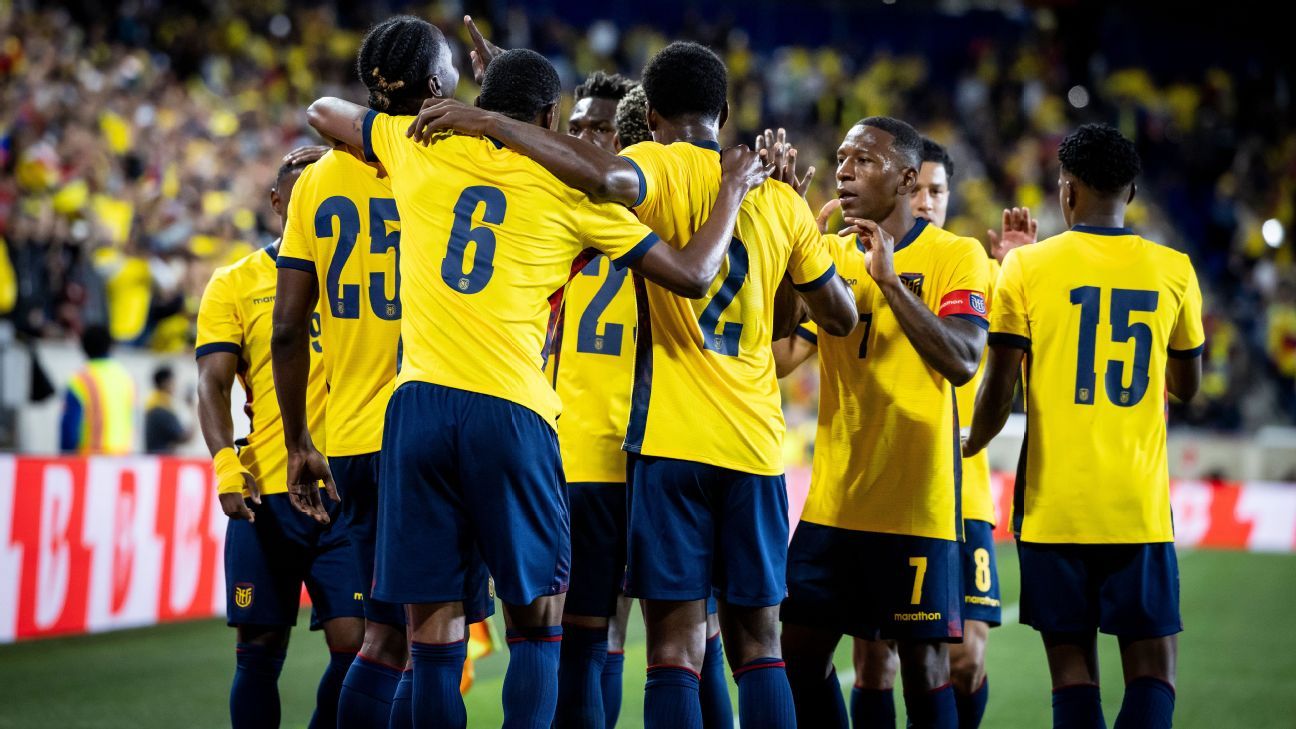
During the 1990 FIFA World Cup in Italy, coach Jack Charlton of the Republic of Ireland made an intriguing discovery: in a tournament where multiple third-place teams could qualify for the knockout rounds, it’s feasible to win the World Cup without securing a single victory in normal time. A combination of draws and success in penalty shootouts could suffice. This insight is relevant as we approach a 48-team tournament, and it explains why many view Ecuador as a potential dark horse this summer.
Ecuador enters their World Cup opener on Sunday against the Ivory Coast boasting a remarkable 19-match unbeaten streak, which includes only eight victories, with three of those coming against relatively weaker opponents in recent friendly matches.
What truly distinguishes them is their solid defensive record. The team has conceded just six goals across 19 matches, a figure that becomes even more impressive after excluding friendly encounters. Critics may argue that South America has an unfair representation at the World Cup (with six out of ten spots and an additional one through an intercontinental playoff), yet the CONMEBOL qualification process is fiercely contested, offering little respite. Remarkably, in their last 11 qualifying matches, Ecuador conceded just one goal.
Their defensive prowess was evident in the UEFA Champions League final, featuring standout players such as Willian Pacho from Paris Saint-Germain and Piero Hincapié representing Arsenal. Along with the talented young player Joel Ordóñez from Club Brugge, Ecuador possesses three agile and skilled center-backs capable of adapting to both three-man and four-man defensive setups.
These players, along with the likes of Chelsea‘s midfielder Moisés Caicedo and others in the squad, are products of Independiente del Valle, a club renowned for its exceptional youth development based on the outskirts of Quito. Over half of the players in Ecuador’s World Cup squad have passed through the ranks of this institution.
If Ecuador emerges from this tournament as a feared opponent, a significant role is played by Independiente del Valle, which exemplifies not just the rise of Ecuadorian football but also symbolizes its growth.
Independiente del Valle underwent a transformation after being acquired by investors in 2007, following a period where Ecuador already showcased their potential by debuting in the 2002 World Cup and advancing to the second round four years later—Ecuador’s best performance to date. The project’s founders recognized a nation’s footballing promise that had previously been overlooked.
Before the 1989 Copa América, Ecuador’s record in the tournament stood at four wins, 14 draws, and 57 defeats, with 69 goals scored and 254 conceded. The country made steady progress through the 1990s, and the real breakthrough came in 1996 with the introduction of the current format for World Cup qualification.
This provided Ecuador with a consistent schedule of matches and guaranteed revenue. The arrival of better foreign coaches was another advantage, especially given the internal rivalries between the two major cities, Quito and Guayaquil. Until then, Ecuador had managed to win only five World Cup qualifiers.
Although Ecuador missed out on the 1998 World Cup in France, they achieved six victories in that qualifying campaign, marking their ascent. Now, after finishing strong in the 2026 qualifiers, they anticipate their fifth World Cup appearance with optimism.
Their burgeoning success can no longer be attributed solely to the altitude advantage of Quito; they are increasingly producing talent that thrives under any circumstances. Remarkably, only two players in the current squad are based in Ecuador. In a confident move, they shifted their last home qualifier to Guayaquil‘s sea level and won 1-0 against Argentina.
Next up are the Ivory Coast, resurrecting unsettling memories from a previous encounter with an African nation in Qatar four years ago. After impressive early games, Ecuador only needed a draw against Senegal to secure knockout qualification, but uncertainty in strategy cost them, leading to a 2-1 loss. Fortunately, the current tournament format is more lenient.
As Argentina learned against Saudi Arabia during the last World Cup, a lengthy unbeaten streak can often lead to unexpected outcomes. This time, the pressure is less intense, and even a victory over Curacao in their second match could suffice for advancement to the round of 32, followed by a final group stage clash with Germany. Once they progress, opponents will find it challenging to penetrate their defense.
Coach Sebastián Beccacece from Argentina aims to build a team that defends like Arsenal while attacking with the flair of Barcelona. Currently, he has achieved partial success, as Ecuador remains heavily reliant on veteran striker Enner Valencia, who was responsible for all of their goals at the 2014 World Cup.
Promising assistance was expected from 19-year-old sensation Kendry Páez, a rising star from Independiente del Valle. Although compared to Phil Foden, unlike the Manchester City player, Páez made it to the World Cup. However, his inclusion has sparked debate, as he has faced challenges in recent years, being loaned by Chelsea first to Strasbourg and then to River Plate.
Help may come in the form of 21-year-old Jeremy Arévalo, born in Spain and previously representing the country at the youth level. Now with VfB Stuttgart, he has shown potential to start in recent matches. A strong, left-footed support striker, it will be intriguing to see how he is utilized during the tournament.
If Ecuador manages to enhance their scoring abilities alongside their defensive rigour, their status as a sleeper team could prove to be well-founded.