



The FIFA World Cup has emerged as a Cinderella story for the United States men’s national team. Their thrilling defeat of Paraguay in the opening match, followed by a solid win against a determined Australia, was slightly overshadowed by a late collapse against Türkiye. This combination of results has significantly raised the expectations for the team back home.
As they advance to the knockout rounds, the U.S. finds itself favored against Bosnia-Herzegovina, who secured their place in the Round of 32 as the fifth-ranked third-place team in the tournament. However, despite the Americans’ impressive form, they can’t afford to feel complacent, even against a team positioned 61st in FIFA’s rankings.
What should the U.S. anticipate on Wednesday at Levi’s Stadium in Santa Clara, California? ESPN consulted Julien Laurens to discuss the tactics Bosnia-Herzegovina will employ, while Jeff Carlisle analyzes how the Americans can respond.
 Set piece specialists prepare to disrupt co-hosts’ momentum
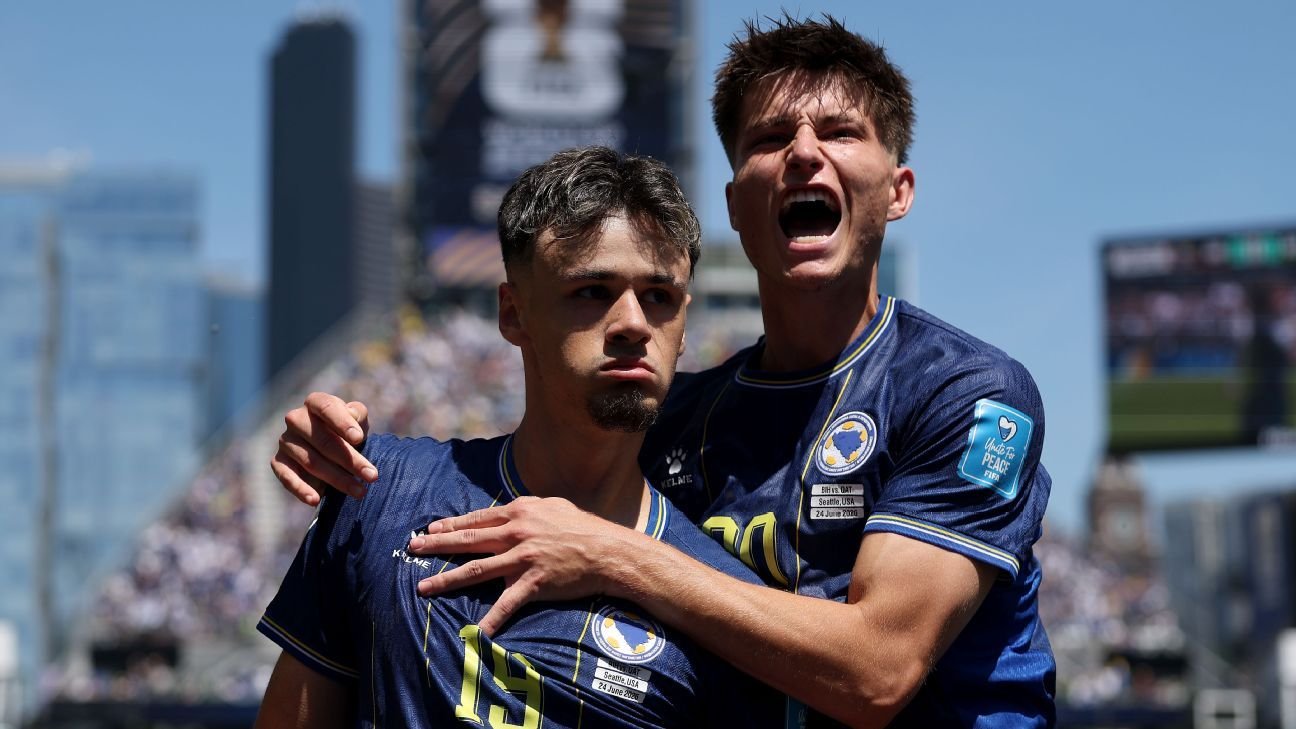
Appointed in 2024, coach Sergej Barbarez, a former player and captain for Bosnia-Herzegovina, brings a fresh perspective after never having managed before. He has infused the squad with youth, including players from the diaspora born in Sweden, Germany, Austria, and the U.S., resulting in 16 new faces debuting over the last two years.
This talented new generation features 18-year-old star Kerim Alajbegovic (playing for RB Salzburg) and includes players like Tarik Muharemovic (23, Sassuolo), Amar Dedic (23, Benfica), Ermin Mahmic (21, Slovan Liberec), and Esmir Bajraktarevic (21, PSV Eindhoven), who was raised in Wisconsin and even played for the U.S. before switching allegiances.
The team’s style was evident during the group stage, with matches against Canada (1-1), Switzerland (1-4), and Qatar (3-1).
Bosnia-Herzegovina has established itself as a physically strong team, known for its prowess in duels and propensity for fouls — averaging 15.7 fouls per game, leading to six yellow cards and one red card, the second most in the tournament. Expect an intense contest against a robust defense.
However, their possession struggles are evident; they rank 33rd out of 48 teams with only 43.7% possession, whereas the U.S. boasts nearly 60%. Their chance-creation has been similarly lackluster, with the 39th-best expected goals (xG) ratio at 1.9. This challenge was evident against Canada, where they managed just eight shots (three on target), and against Switzerland, with only five shots (three on target). As a result, the U.S. is likely to enjoy more possession and must find ways to break down Bosnia-Herzegovina’s likely five-man defense, similar to what they encountered against Switzerland and Canada.
Nevertheless, Bosnia-Herzegovina excels at set pieces, having netted three goals off these situations compared to just one from open play, making them a constant threat in this regard. The team features players capable of delivering accurate crosses and has considerable height advantage.
Additionally, there remain individuals capable of producing moments of brilliance. The team’s captain and four-time veteran, Edin Dzeko, with 150 caps and 73 goals, may not be as sharp as in his youth but can still convert good chances. The dynamic play of the young wingers—Alajbegovic, who netted a stunning goal against Qatar, and Bajraktarevic on the opposite flank—adds to their offensive threat. The explosive speed of Mahmic, who has scored twice, poses further problems for the U.S. The Americans must remain alert to threats from the wings while maintaining a solid defensive structure during set pieces. — Laurens
 U.S. must remain disciplined against a formidable opponent
The United States will encounter a Bosnia-Herzegovina team that shares similarities with their earlier opponents, Paraguay and Australia. Both of those teams preferred to wait in a low block and hit on the counter, and Bosnia-Herzegovina will likely adopt a similar approach. However, U.S. defender Tim Ream emphasized the need to “expect the unexpected.”
The U.S. has shown strong performances in these earlier matches, largely due to an effective press that stifled opposition play and allowed them to control the pace of the game. Early goals made a significant contribution, enabling the Americans to dictate proceedings and build on their advantages.
The return of Christian Pulisic from a calf injury is a major boost for the team. His absence has been felt; the U.S. attack has lacked fluidity without him. In his brief appearance against Türkiye, Pulisic illustrated how his presence enhances the squad’s dynamics. His creativity and incisive runs will be crucial in breaking down a likely resilient Bosnia-Herzegovina defense.
The midfield trio of Tyler Adams, Weston McKennie, and Malik Tillman must perform at their peak, particularly during transitions. Adams, in particular, is tasked with disrupting opposition plays early, which will be critical in mitigating the impacts of Bajraktarevic and Alajbegovic on counterattacks.
As the tournament progresses, expectations for this U.S. squad have risen. It’s rare for them to be viewed as favorites in a World Cup knockout match, and with a supportive crowd in Santa Clara, the pressure to deliver a strong performance is significant. Patience and discipline will be key virtues for the U.S. in pursuit of victory, especially if an early goal remains elusive.
A potential game-changer from the bench could be Gio Reyna. The Borussia Mönchengladbach midfielder delivered a spectacular goal in the tournament opener against Paraguay and may provide the necessary spark if the U.S. requires a special moment late in the match. — Carlisle