



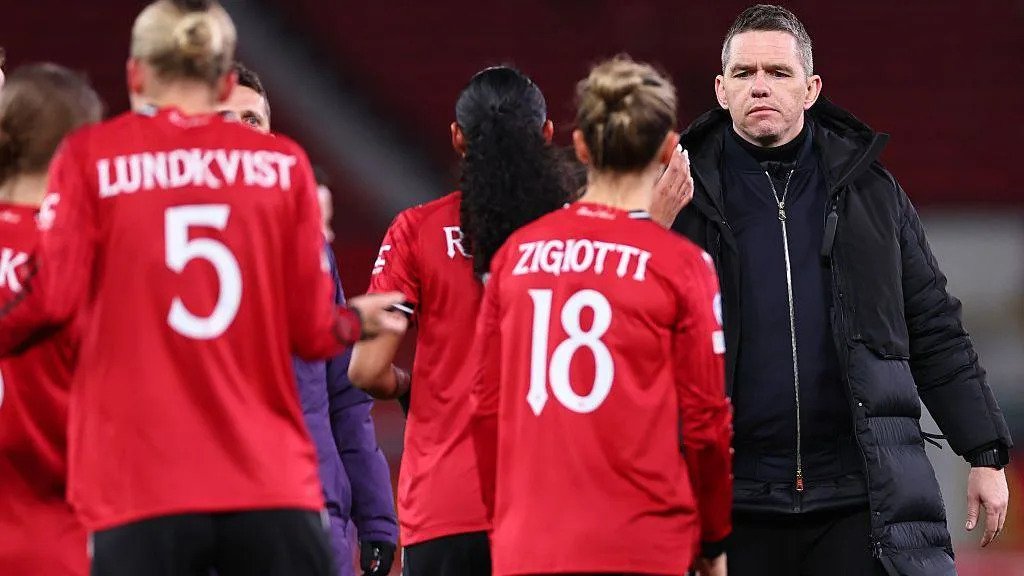
With just a month remaining before the Women’s Super League season kicks off, Manchester United finds itself without a manager and facing a limited squad.
On Monday, the club announced that Marc Skinner has left his role by mutual agreement, bringing an end to his five-year tenure, which included securing the club’s first major trophy.
Advertisement
The timing of his departure has raised concerns over United’s potential to fall behind after a quiet summer in terms of recruitment.
Previously criticized for their women’s program, the club’s current course raises questions: Are they scaling back resources, pursuing a more sustainable model, or shifting towards a new strategy?
What prompted Skinner’s exit?
In April, Skinner faced inquiries regarding his future but confidently stated that he had “no doubts” about being the right person for the job.
Leading up to the World Sevens tournament in May, there had been no internal discussions regarding his position, and the club was content with their progress.
Advertisement
Expectations were focused on challenging for trophies and aiming for European qualification again. United had lost the League Cup final to Chelsea and finished nine points off a top-three finish, although they did reach the Champions League quarter-finals.
Ultimately, despite operating on a considerably lower budget than their top-three counterparts (with a wage bill of £5.9m for 2024-25 compared to Chelsea’s £14.5m), Skinner managed a commendable performance under intense scrutiny from fans.
However, as the new season approached, club sources indicated that discussions revealed a misalignment between Skinner and the club regarding their future direction.
While United aimed to focus on a sustainable model emphasizing youth development, Skinner expressed growing frustration over a lack of investment in the squad.
Advertisement
After a 3-0 defeat by Manchester City in March, he remarked: “The team is giving everything they can. I believe that with the right investment in key areas, we can meet those expectations.”
He reiterated his concerns following their cup final loss to Chelsea and again on the season’s final day, as they looked towards the summer transfer window.
Despite a quiet January, United has been slow to act this summer, signing only 22-year-old defender Andrea Medina and goalkeeper Janina Leitzig, who is expected to serve as backup to the established Phallon Tullis-Joyce.
While United treads carefully in the transfer market, their competitors are making significant signings, such as Arsenal, who brought in England international Georgia Stanway and Spanish full-back Ona Batlle. Chelsea, meanwhile, acquired one of United’s key players, Melvine Malard for £850,000.
Advertisement
Skinner had struggled to connect with the fans, and under pressure from external scrutiny, coupled with a thin squad and clear disagreements over spending, his position became untenable.
Why has United’s commitment been questioned?
This is not the first time United’s investment has come under scrutiny.
Former manager Casey Stoney resigned in 2021 due to rising concerns over insufficient resources and facilities.
Subsequent reports highlighted the inadequate training facilities in 2024, while comments made by owner Sir Jim Ratcliffe regarding the women’s team faced criticism.
Advertisement
Moreover, they have lost several key staff members, including ex-assistant Martin Ho, now successful as Tottenham’s manager, along with goalkeeping coach Ian Willcock in April. Another former assistant, Charlotte Healy, became the head coach at WSL 2 club Bristol City last year.
When Skinner took the helm at United in 2021, he was following in the footsteps of a beloved figure among fans, Casey Stoney.
His standing diminished further as notable players departed on free transfers, notably England stars Alessia Russo and Mary Earps, along with Batlle.
Are the club addressing these challenges?
Manchester United has made efforts to retain major players by selling Malard last month for a significant profit intended for reinvestment.
Advertisement
Additionally, they gained from the sales of Millie Turner and Lisa Naalsund to Birmingham City, both for six-figure fees.
BBC Sport reported in July that the young girls’ academy will hold training sessions at Carrington, the club’s primary training ground, this season.
This initiative is part of their new strategy, which club insiders claim is focused on a sustainable future with a commitment to nurturing homegrown talent.
United asserts that there has been “significant” investment in the academy amid concerns that current spending patterns within the WSL are unsustainable.
The ambition is for this strategic approach to yield long-term success for United, utilizing transfer fees obtained thus far to bolster the club’s overall structure.
Advertisement
It appears the search for Skinner’s successor is already well underway, with hopes of appointing a new head coach promptly.
A key criterion for Skinner’s replacement will be a proven record in talent development, and with no European commitments this season, United anticipates more chances for younger players to see action in the WSL.
However, the pressing question remains: Will this strategy produce the results that fans desire?
Former manager Stoney stated in May: “Are they at the same level as the top clubs? Perhaps not in terms of salaries and recruitment.
“If they aspire to reach greater heights, they will need to invest more in the squad to enhance depth.
Advertisement
“Your team’s performance is contingent on the quality of players available on the pitch. It’s about the investment you are willing to make.”
For interviews and more content from the Women’s Super League and beyond, check out the Women’s Football Weekly feed