



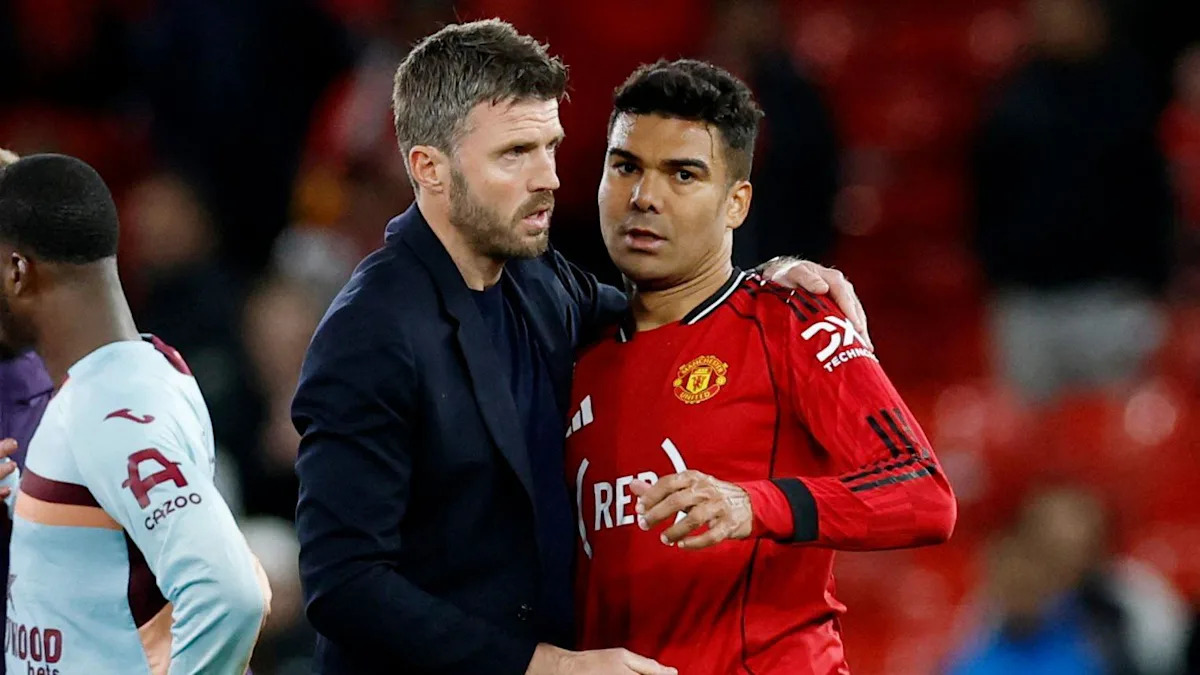
“One more year, one more year Casemiro,” rang out from the Stretford End as the Brazilian midfielder proceeded down the tunnel towards the Manchester United dressing room.
The 34-year-old had just completed a full 90 minutes in a 2-1 victory against Brentford, a match that showcased why he is such an essential player.
Advertisement
After scoring for the third consecutive home match, he celebrated by kissing the badge on his shirt while joyfully pointing at it. He knows how to engage with the crowd.
In addition to his goal, he earned two free-kicks in the home penalty area, cleverly drawing contact from Nathan Collins as Brentford sought an equalizer.
His contributions were invaluable, emphasizing the void that will be felt in the next season when Casemiro is expected to embark on a new chapter in his career, possibly in the United States if rumors prove true.
“Yes,” acknowledged manager Michael Carrick when asked if the Brazilian’s United career would indeed conclude next month. “It’s clear from both sides.”
Advertisement
Addressing midfield gaps is Manchester United’s top priority this summer.
The team’s recent win positions them just two points shy of Champions League qualification after two years out. With four games remaining, they would need to lose them all while teams like Brighton or Bournemouth would need to secure victories in all their matches. Although this won’t be officially stated, the task outlined by technical director Jason Wilcox following Ruben Amorim’s dismissal in January has been termed successful by the United squad.
Now, pivotal decisions regarding players and management need to be made.
Replacing Casemiro stands out as one of the most significant challenges.
Advertisement
“Cas has influenced the squad tremendously,” said Carrick. “His vast experience is invaluable, and he gives everything he can. But that’s football; players come and go.”

Casemiro is the second player in Premier League history to score eight or more headed goals in a season for Manchester United, alongside Dwight Yorke (also with eight) during the 1999-2000 season [Getty Images]
‘Transfer strategy will significantly differ from previous approaches’
Strengthening the central midfield is of utmost importance. Nottingham Forest‘s Elliott Anderson tops the wish list.
However, there’s a growing sentiment at Old Trafford that the transfer strategy this summer will markedly differ from past timelines in two key ways.
First, it has been emphasized that the club will resist overpaying. If the asking price for Anderson, currently valued at £120m—also pursued by Manchester City among others—remains high, they will not pursue it. Each player’s value has its limits, regardless of their reputation.
Advertisement
Secondly, they plan to avoid drawn-out negotiations before shifting focus once the season commences. This strategy is what led to Casemiro’s arrival at Old Trafford in 2022, following Erik ten Hag’s protracted pursuit of Frenkie de Jong, which ended unsuccessfully.
It’s evident, although being reiterated, that United’s recruitment team has numerous potential alternatives. If Anderson is not secured, the club hierarchy believes there are other players who can elevate their existing squad.
The acquisitions of Bryan Mbeumo and Matheus Cunha last summer serve as a model, demonstrating that quality players can be drawn to the club.
United recognize that their roster needs expansion to meet the demands of a season that could see a 50% increase in matches compared to the current 40-match schedule.
Advertisement
There’s an understanding that not every signing will yield results, but this strategy aims to avoid excessive expenditures and inflated contracts that can be challenging to manage, much as seen with Marcus Rashford and Andre Onana, whose presence still looms over United.
It’s also recognized that while certain players—like Harry Maguire and Luke Shaw—may find it difficult to play more frequently, others, like Noussair Mazraoui, have not had adequate playing time.
Ayden Heaven has excelled defensively, and there is optimism regarding his future contributions next season. Matthijs de Ligt may currently be sidelined due to a back injury, but once fit, there’s confidence he can manage the demands of a busier season.
Acquiring two, and possibly three, central midfielders is deemed essential, along with a left-sided attacking player, as United had previously shown interest in Antoine Semenyo in January.
Advertisement
‘Deciding on Carrick is a precarious choice’
Before any of this, a decision must be made regarding Carrick.
Many believe that leading the team back to the Champions League—even if it was suggested early on that his squad might struggle—should be sufficient for him to receive a full-time contract.
Removing Carrick, supporters argue, would be the most uncertain choice.
However, there are differing perspectives.
The first viewpoint suggests Carrick deserves the opportunity in light of his work; if things falter next season, the United hierarchy could face criticism for replicating the Ole Gunnar Solskjaer approach—even though that underestimates Solskjaer’s achievement of securing consecutive top-four finishes, a feat not matched since Sir Alex Ferguson’s retirement.
Advertisement
The alternative perspective holds that opting for a more seasoned manager may lead to struggles in adaptation, resulting in accusations that the leadership attempted to rectify an issue that wasn’t present.
This dilemma is complicated by the understanding that Paris St-Germain appears confident that standout candidate Luis Enrique will renew his contract, and even if he remains available, will demand among the highest wages globally to switch teams.
The logistics of hiring someone like Julian Nagelsmann—whose contract with Germany extends until 2028 and may participate in the World Cup final a day after Manchester United’s first pre-season matchup against Wrexham in Helsinki—renders this a less feasible route.
Andoni Iraola holds favor within the club, yet as Thomas Frank learned during discussions with United in 2024, leading a smaller, progressive Premier League club poses a contrasting challenge compared to managing a top-tier team.
Advertisement
When Carrick was asked to take command until season’s end, there were uncertainties regarding his potential results. Nevertheless, United’s leadership was assured he would not be overwhelmed by the enormity of the role he was undertaking.
Carrick met Sir Jim Ratcliffe for a casual conversation over tea last week; its significance remains to be seen.
Providing there is no shocking sequence of outcomes, Old Trafford is poised to welcome Champions League football again next season.
However, it feels as if for those at the helm, their most pivotal tasks are just beginning.