



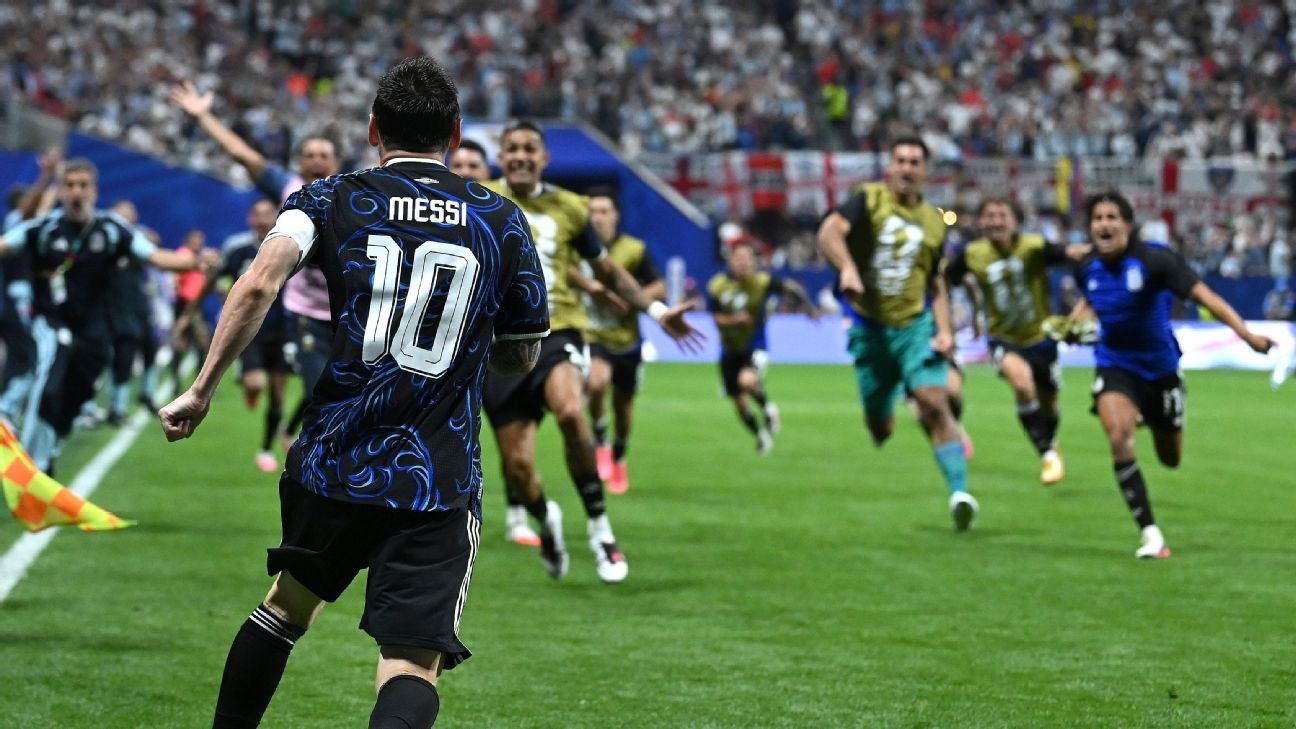
This FIFA World Cup has once again shown us that underestimating Lionel Messi is a mistake. As he approaches the potential end of his international career this Sunday in East Rutherford, New Jersey, against the very team that could have redirected his path, anything feels possible.
Those of us who witnessed the South American Under-20 Championship in Colombia back in early 2005 will always remember that moment.
At just 17, Argentina showcased a young playmaker with a mop of hair and a left foot that amazed us all. He looked like a regular teen, hardly resembling a top athlete—until he took to the field.
Over 21 years ago, Messi was already delivering performances that left us in awe. The way the ball adhered to his left foot was almost supernatural, and he possessed an uncanny ability to read the game and exploit spaces to outmaneuver defenses. It was clear from the outset that he was destined for greatness, and all of us fortunate enough to watch him knew we were witnessing something extraordinary.
At that time, he was relatively unknown. Having moved from Rosario to Barcelona at 13, Messi had played only a few matches for the club, and even his own country had limited familiarity with him. However, they were aware that Spain was eager to enlist him, prompting Argentina to act swiftly.
Argentina seized the opportunity and invited Messi to represent his homeland in a friendly against Hungary on August 17, 2005, although he was sent off just minutes into his debut.
For a time, his decision was heavily criticized, especially as Spain triumphed in the World Cup in 2010 and secured the European Championship in 2008 and 2012, while Argentina struggled. A decade ago, after another devastating loss to Chile in the Copa América—in the same stadium where he will be playing this Sunday—Messi announced his retirement from international football.
Fortunately, he reversed that decision, and soccer has benefited immensely from it. In the last five years, Argentina has broken a lengthy drought with two Copa América victories, plus a World Cup win in Qatar four years ago, and now they aim to defend their title against Spain in Sunday’s final.
Sunday’s match also marks a reunion for the two coaches. Almost ten years ago, Lionel Scaloni, now coach of Argentina, was earning his coaching credentials in Spain, where his instructor was Luis de la Fuente, who will lead Spain in the upcoming match.
There are numerous connections between the teams. Earlier in the tournament, when asked about the foreign player he would most like to add to his Spain squad, De la Fuente responded almost immediately, saying it would be Argentina’s Julián Álvarez. As De la Fuente strategizes for the final, he will focus on how to mitigate the threat posed by Álvarez and Messi’s partnership.
His task of countering their threat will be far more pragmatic than that of England coach Thomas Tuchel, who resorted to a deep defensive strategy that made his team resemble bats clinging to their goalposts. Spain, characterized by their ball possession approach, will attempt to keep the ball away from Messi and Álvarez as effectively as they did in their semifinal victory over Kylian Mbappé and Co. in their win against France.
We are set for an intriguing battle of styles, as Argentina and Spain were supposed to meet in the Finalissima, a showdown between the champions of Europe and South America.
Argentina sought to arrange the match last year, but scheduling conflicts prevented it. The combination of FIFA World Cup qualifiers and the UEFA Nations League makes it challenging for European clubs to compete against teams from other continents outside of World Cup events.
After defeating France in the 2022 final, Argentina did not encounter European sides again until facing Iceland in a warmup match before this year’s World Cup. Although the Finalissima was slated for March in Doha, it was canceled due to escalating political tensions in the region.
Spain suggested alternative European opponents, while Argentina proposed Buenos Aires as a venue, knowing Spain would decline. Consequently, the match never took place, but now the stakes are infinitely higher.
It’s finally happening, but with the ultimate prize— the World Cup—on the line.