



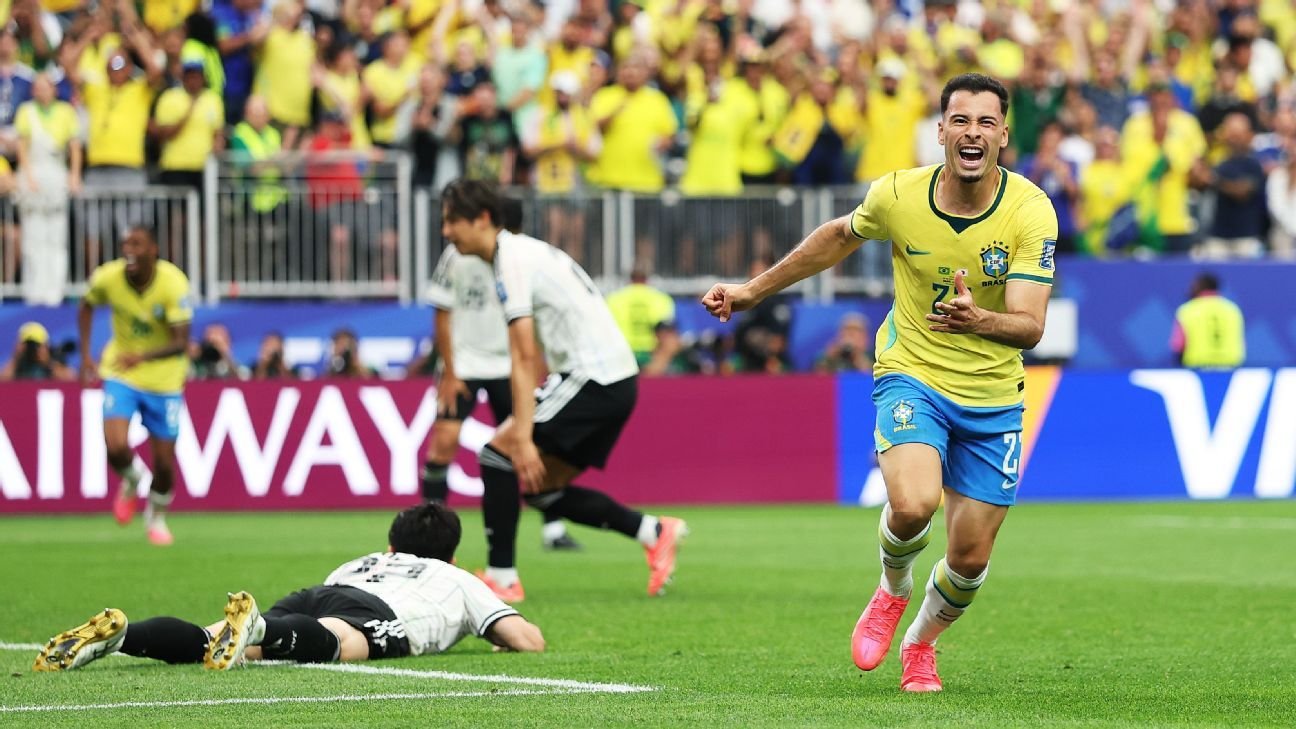
HOUSTON — Gabriel Martinelli found the net just five minutes into stoppage time, securing a 2-1 victory for Brazil against Japan in Houston. The five-time FIFA World Cup champions rebounded from a first-half deficit after Kaishu Sano‘s stunning opener.
Japan’s 29th-minute goal put Carlo Ancelotti’s side in a precarious position, threatening Brazil with the possibility of a historic defeat against an Asian team. However, a powerful header from Casemiro leveled the score at 56 minutes, leading to a determined effort from the Seleção to find a winning goal.
Despite Brazil’s persistence, Japan’s goalkeeper Zion Suzuki delivered a series of crucial saves to keep the game tied. However, in the dying moments, Arsenal forward Martinelli scored from close range after being set up by Bruno Guimarães, clinching victory and advancing Brazil to the round of 16.
Brazil’s next match will be against the winner of the upcoming fixture between Norway and Ivory Coast in New Jersey on Sunday.
– World Cup 2026 bracket: Every team’s path to the final
– Which World Cup front-runner needs its superstar more?
– Why every round-of-32 team will, won’t win World Cup
Brazil Evades Upset: Are They Too Old for a World Cup Win?
Casemiro’s pivotal midfield performance and equalizing goal underscored his significance to Ancelotti’s squad, though his age—34—raises questions about Brazil’s overall experience, especially given the average squad age of 29 years and 245 days, making it the second-oldest team Brazil has ever fielded in a World Cup since 1966.
Alongside Casemiro, players like Alisson Becker (33), Danilo (34), Marquinhos (32), and Douglas Santos (32) featured in the match, and their mobility appeared to be tested as Japan’s pace caused issues for Brazil in the first half.
While Ancelotti may argue that his team’s experience played a critical role in securing the win, the lack of emerging young talents has resulted in one of the oldest lineups in the tournament. As Brazil prepares for more significant challenges, such as a potential clash with Norway in the round of 16, doubts linger about their ability to sustain their World Cup ambitions.
A Frustrating Day for Vinícius Júnior
This match showcased both the brilliance and the struggles of Vinícius Júnior. The Real Madrid forward has proven to be one of the most dynamic players at the club level, yet he has struggled to replicate that form for the national team.
With only 13 goals in 53 appearances, his scoring record pales in comparison to stars like Kylian Mbappé, Harry Kane, and Erling Haaland.
Despite this, the 25-year-old came close to igniting the match with a spectacular second-half run, but his shot was spectacularly saved by Suzuki, rebounding off the post. However, Vinícius quickly reverted to frustration, highlighting his need to deliver in critical moments if he aims for the Ballon d’Or.
Casemiro’s Impact on the Game
Following an impressive season at Manchester United, where he scored eight important headers, Casemiro showcased why he is vital to Brazil. He headed the team back into contention with a classic goal early in the second half, marking his fifth header among his 10 international goals.
While Casemiro’s experience is invaluable, he appears to have suffered a groin injury late in the match, posing a potential risk for Brazil’s next fixture and for coach Ancelotti.
1:31
Nicol: Ancelotti not playing Neymar shows he does not trust him
Japan’s Knockout Challenges Persist
Japan’s history in knockout phases remains disappointing, failing to progress beyond the first stage for the fifth consecutive time.
Despite earlier impressive wins, including victories over Germany and Spain in group stages, the Samurai Blue have yet to deliver when it matters most.
Japan matched Brazil in the first half but ultimately squandered a golden opportunity after holding a halftime lead, leading to questions of their mental resilience when stakes are highest.
The term “the wall of the last 16,” coined by veteran player Yuto Nagatomo, has persisted, representing a barrier Japan must conquer, which—thanks to tournament expansions—now applies to the last 32.
Moriyasu’s Tactical Struggles
Japan coach Hajime Moriyasu crafted a first-half tactical plan that effectively stymied Brazil’s attack.
Though Brazil dominated possession, Japanese forwards Vinícius Júnior (23), Matheus Cunha (21), and Rayan (17) struggled to make an impact, showcasing Japan’s disciplined defensive structure.
Pressure led to Sano’s opening goal, but after halftime, a more conservative approach stifled their earlier success. Once Brazil equalized, Japan’s strategy faltered, resulting in a quick concession of the winning goal.
Moriyasu shifted tactics to prioritize defensive stability, substituting offensive players, yet for a team proclaiming aspirations to win the World Cup, their caution might reflect a deeper lack of self-belief.
1:27
Laurens left disappointed by Japan’s game plan in Brazil defeat
Evaluating Asia’s World Cup Performance
The Asian Football Confederation (AFC) initially shined, as its teams stayed unbeaten in their first six matches. However, the momentum quickly dissipated.
Australia remains the AFC’s last hope as they prepare to face Egypt on Friday. Despite some commendable performances, there have been disappointing campaigns.
Japan, while showing promise, has failed to convert group stage successes into knockout stage progression, making this World Cup particularly disappointing for the continent. Teams like South Korea and Saudi Arabia exhibited underwhelming results, while both Iraq and Qatar had disappointing showings despite earlier hopes.
In contrast, teams such as Iran showed resilience, leaving with hard-fought draws, while debutants like Uzbekistan and Jordan gained invaluable experience.
Overall, this World Cup might be remembered as a disappointment for Asian teams, and they will have to wait four more years to improve their standing.
— Gabe Tan