



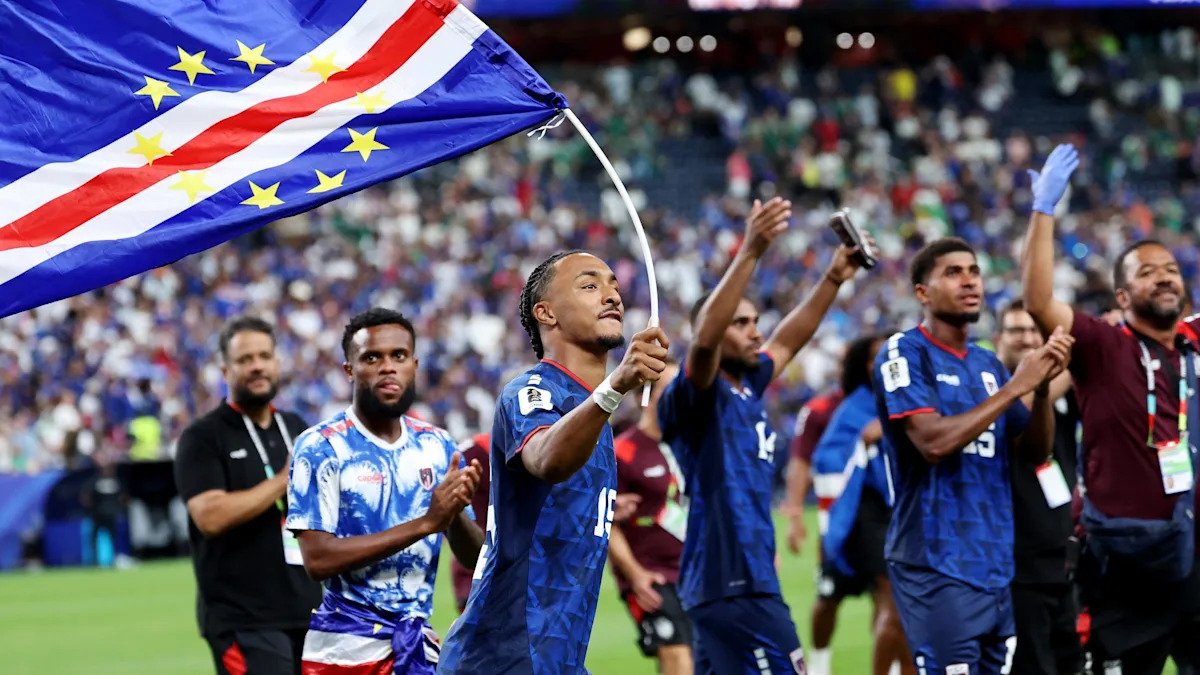
Cape Verde has made history as the smallest nation ever to reach the knockout stage of the World Cup.
This remarkable achievement for the team representing a group of 10 islands in the Atlantic Ocean comes with the formidable challenge of facing the defending champions, Argentina in the Round of 32.
Advertisement
After their goalless draw against Saudi Arabia, players gathered around a mobile phone on the pitch to witness the final moments of Spain’s victory over Uruguay, which confirmed Cape Verde’s second-place finish in Group H.
“There were tears of pride and joy all around the stands,” said Rob Law, a commentator for BBC Radio 5 Live in Houston.
“It was a beautiful moment as they all huddled together, eagerly waiting for the full-time whistle. When it blew, tears flowed both on the pitch and in the stands. What a memorable moment – truly the highlight of the World Cup so far.”
Advertisement
This exciting journey began with a remarkable goalless draw against Spain, where Vozinha, their 40-year-old goalkeeper, emerged as the hero, followed by a thrilling 2-2 draw against two-time World Cup champions Uruguay.
“What they have achieved is unbelievable; it wasn’t just one game against Spain but three matches at the highest level,” remarked former World Cup winner Juan Mata on ITV.
How has this nation of just 525,000 residents defied the odds, qualifying ahead of five-time African champions Cameroon?
Diaspora Influence and Aspirations
The significant factor behind the Blue Sharks’ success stems from the Cape Verde Football Federation’s (FCF) strategic recruitment of players from the nation’s diaspora.
Advertisement
There are deep connections to the former colonial power, Portugal. Severe droughts in the last century prompted significant emigration from the islands, while the maritime trade tradition has resulted in a considerable population of Cape Verdeans in Rotterdam.
Out of their 26-man World Cup squad, 14 players were born overseas, including six from the Dutch port city.
One notable player, forward Dailon Livramento, who played for Casa Pia in Portugal’s Primeira Liga last season, scored the crucial goal in their qualifying win over Cameroon last September.
“The FCF has made tremendous strides through passion, dedication, and a coherent technical plan,” stated Josina Freitas Fortes, a member of Cape Verde’s parliament, to BBC Sport Africa.
Advertisement
“The achievements we’re witnessing are fruits of years of consistent effort, unwavering belief, and individuals who have committed themselves to the project.”
The story of recruiting Dublin-born center-back Roberto Lopes via LinkedIn in 2019 is one of many examples; former Manchester United winger Bebe was also part of their 2023 Africa Cup of Nations (Afcon) squad, having represented Portugal at the under-21 level.
“There’s a confidence within this team that we can compete against the best in the world,” Lopes commented.
“This isn’t just an overnight success; there’s been a sustained effort to position Cape Verde alongside the leading football nations globally.”
Advertisement
Stable Coaching – Strength, Unity, Resilience
Much of Cape Verde’s success can be attributed to coach Bubista, a former international who has led the team since January 2020.
The stable coaching environment has allowed the 56-year-old former defender to develop a compact and cohesive unit, featuring a well-organized defense, technical midfielders, and talented forwards, enabling them to outmaneuver teams like Ghana and draw against Egypt during their run to the quarter-finals at the 2023 Afcon, just ten years after making their tournament debut.
While Vozinha’s impressive seven saves in the goalless draw with Spain were commendable, the Blue Sharks’ discipline was emphasized by their record of conceding only one foul, the lowest number recorded by any team in a World Cup match since 1966.
Advertisement
“We always train and play as one unit, so what we did in the game felt familiar to us,” defender Sidny Lopes Cabral communicated to the BBC World Service.
“For us, it’s our game. This is how we play, this is our identity as a team and as defenders.”
In their second game against Uruguay, Cape Verde adopted a more aggressive approach but maintained their resilience, fighting back to secure a second-half equalizer.
“More than the result, it’s essential to demonstrate our identity as a team, showcasing our strength, unity, and resilience,” stated Bubista.
Advertisement
For his remarkable guidance in leading the team to World Cup qualification, Bubista was honored as the African Coach of the Year for 2025 by the Confederation of African Football.
He has always believed in his team’s ability to compete with the world’s best.
“Considering our country’s small size, we have performed remarkably well,” he said to BBC Sport Africa ahead of the 2021 Afcon when the Blue Sharks advanced to the last 16.
“I foresee Cape Verde participating in future World Cups.”
This bold prediction has come true, and now Bubista hopes that Cape Verde’s achievements at this expanded tournament will inspire other underdog teams around the world.
Advertisement
“I believe football is for everyone,” he concluded.
The Prize? Facing Argentina in the Knockouts
Cape Verde’s reward is to take on Lionel Messi‘s Argentina in Miami during the Round of 32 on Friday.
“For us, nothing is impossible,” Bubista said at a press conference after the draw against Saudi Arabia, wrapped in his country’s flag.
“From the outset, our aim has been to present our country to the world.”
“To have the opportunity to play against Argentina and Messi at this stage is fantastic for our country, regardless of the match outcome.”
Advertisement
Midfielder Deroy Duarte, who was named man of the match against Saudi Arabia, expressed his excitement: “Honestly, it’s surreal. It feels like I’m living a dream.
“First, let’s celebrate! We’re overjoyed and hope all Cape Verdeans are too. From tomorrow, we’ll shift our focus to the next match.
“We’re up against Argentina, right? It’ll be a tough match, but we must have faith. Anything is possible.”
Former Tottenham, Nottingham Forest, Celtic, and Australia coach Ange Postecoglou commented on ITV: “This is what the World Cup is truly about—a wonderful story.
“Football reaches every corner of the globe, and this exemplifies that.
Advertisement
“It just adds to their narrative. Competing against the reigning champions is a fantastic story.”
Former England and Manchester United defender Gary Neville added: “I believe skeptics who questioned the expansion of the World Cup might change their minds after witnessing the Cape Verde fans; this is genuinely special.
“A nation of 500,000 reaching the knockout stage is an incredible moment. We’ve observed Uruguay, one of the largest nations, exit the tournament while one of the smallest teams advances. What a remarkable achievement for them.”