



AUBURN, Ala. — Leo Messi has captivated audiences globally with his extraordinary talent, leaving billions of soccer fans in awe with moments that may never be replicated. Yet, few times has he graced a stadium where his presence might play second fiddle to the legacy of others who have graced the same field.
On the iconic Jordan-Hare Stadium pitch, where legends like Bo Jackson and Cam Newton achieved greatness and Chris Davis made history by evading 11 defenders, Messi’s Argentina faced off against Iceland in a World Cup friendly on a strangely delightful night that crossed cultural boundaries.
When Messi finally found the back of the net, it turned an already exciting evening into something magical. Though just an exhibition match, Argentina’s 3-0 victory wasn’t the highlight; it was the sheer joy and community spirit that enveloped Jordan-Hare.
College football has often been the closest American parallel to international soccer—not in play, maybe, but in the passionate and territorial fan bases built over generations. While Argentina fans may chant and celebrate, Auburn fans are equally dedicated to tailgating and game day traditions. Despite these differences, an underlying devotion and sense of community binds both groups.
Moreover, the grand stadiums of American football provide excellent venues for welcoming large crowds. While they might not comply with every FIFA requirement for a full World Cup, they create the perfect atmosphere for friendly matches, allowing two distinct sporting cultures to share their traditions.
The origins of this friendly match trace back over a year and a half, with three letters—NIL—playing a significant role in drawing Messi to The Plains. As the costs of college athletics continue to rise, institutions must adopt creative methods to generate revenue, and a match featuring the defending World Cup champions is a profitable venture.
“How can we drive revenue and grow our department’s income without overburdening our fans?” posed Rhett Hobart, Auburn’s chief revenue officer, to Yahoo Sports. “Increasing ticket prices or event costs seems like an easy route, but we aim to find ways to host events beneficial to the city and drive revenue for the department without raising costs for our supporters.”

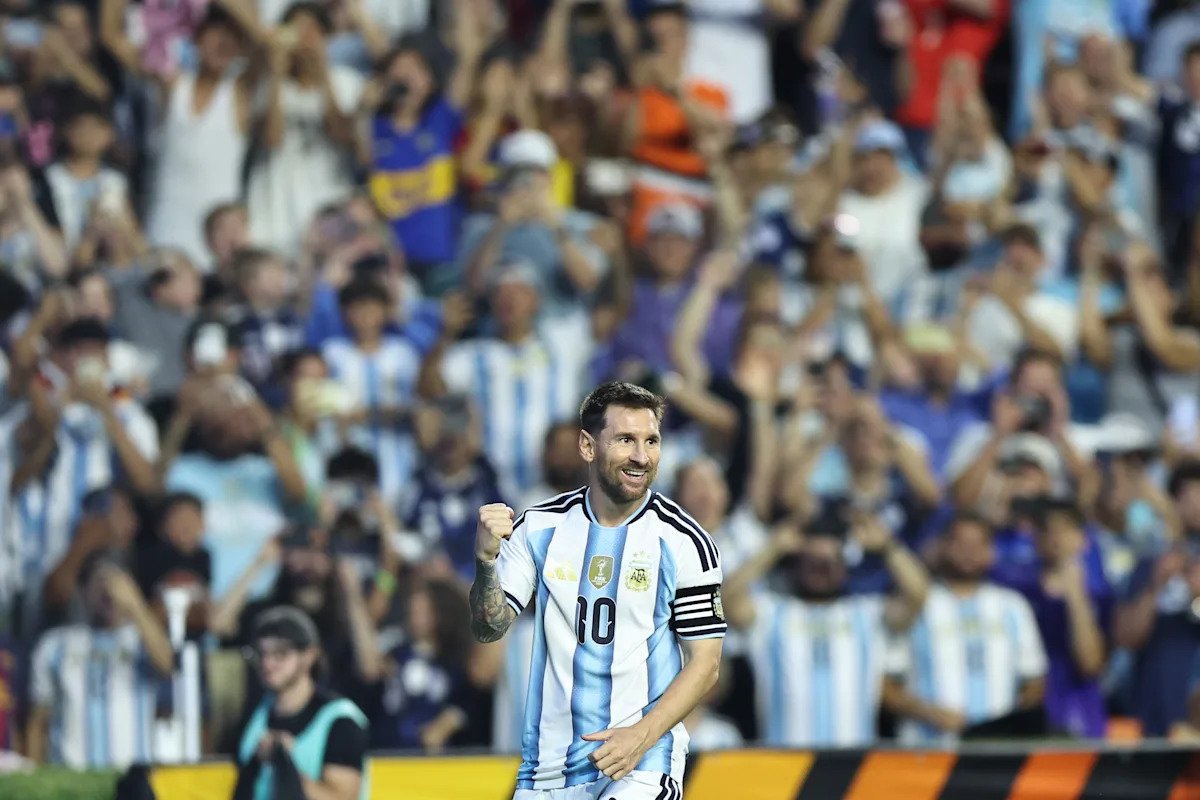
Lionel Messi of Argentina celebrates after scoring during the international friendly match against Iceland at Jordan-Hare Stadium on June 09, 2026 in Auburn, Alabama.
(Omar Vega via Getty Images)
Auburn collaborated with Unified Events and Florida Citrus Sports to organize this match, working tirelessly to secure a friendly in the lead-up to the World Cup. After several initial setbacks, they finally landed the opportunity to host the reigning champions and the legendary Messi—an impressive feat for the Loveliest Little Village on the Plains.
“In the World Cup year, we aimed to spotlight underserved communities that typically miss out on such events,” explained Molly Pendleton, SVP of Unified Events. “Situated just an hour and a half from Atlanta—where soccer is frequently showcased—Auburn hosts a fervent fan base eager for more events.”
Auburn’s iconic War Eagle pregame flight added a distinctiveness to the event. While traditionally a football custom, on this particular evening, it became a soccer tradition as well.
“For an event at Jordan-Hare, we want to ensure its uniqueness,” stated Hobart. “We celebrate soccer in a way it’s appreciated globally, incorporating all the pregame festivities. But how do we give it our own Auburn twist? The first thing we proposed was, ‘How about an eagle’s flight pregame?’ They were thrilled from the outset.”
Representatives from Auburn visited Gillette Stadium for a friendly match to gather insights, while an Argentina team visited Jordan-Hare to assess the field and conditions. Everyone left with mutual satisfaction, leading up to this much-anticipated event.
This Argentina friendly is part of a growing trend where universities host major sporting events that might typically gravitate towards larger urban areas. Last year, Auburn’s Plainsman Park welcomed the Savannah Bananas, and a Zach Bryan concert is on the schedule for the fall. However, these events require extensive logistics, planning, security, and resources that a major team, particularly one just days away from the World Cup, demands. From hotel rooms to police escorts, the list is extensive, and Auburn was prepared to deliver.
Although Auburn hasn’t disclosed expected revenue from the match, a Memorandum of Understanding states the university will receive 60% of “net event revenue,” which encompasses ticket sales, merchandise, and parking.
In return, Auburn promised to provide a “pristine” playing surface at no cost, alongside all necessary operations to offer an experience akin to a college football game day. Argentina will earn $2.4 million, while Iceland will receive $325,000 for their participation.
As game day approached, fewer than 4,000 tickets remained available, with initial prices starting at a modest $45. In stark contrast to typical FIFA pricing, tickets were still available for $78 on game day. Hobart estimated a $10 million economic impact on the Auburn-Opelika community, a considerable boost for this typically quiet summer period.
Despite careful planning, Mother Nature briefly intervened, with heavy rain on Tuesday afternoon dampening pre-match spirits as Argentina supporters sought shelter. Still, long lines formed for the famous Toomer’s Lemonade, showing the resilience of the fan base.
Fortunately, the rain subsided just an hour before kickoff, and the sunset cast an Auburn-orange hue across the clouds. To honor the visiting fans, the stadium played popular tracks such as “Mentirosa” by Ráfaga, while Auburn’s usual pregame music was notably absent.
Fans lined the concourses, excitedly grabbing hot dogs, drinks, and merchandise. On the field, workers quickly dried out the playing surface, and what had been a soggy pitch just moments earlier was now ready for the world’s greatest player and his team.
Shortly before kickoff, the eagle completed its majestic flight, adding to the event’s allure and leaving international guests both amazed and perplexed.
The event’s Memorandum of Understanding mandated that Messi at least attend the match, or risk a $250,000 penalty. Ensuring compliance, he practiced with the team in preparation.
When Messi emerged onto the pitch at Jordan-Hare about 30 minutes before the match, he received a warm reception from the crowd, instantly energizing the thousands of fans present.
On the field, the match was somewhat lackluster. Argentine player Valentin Barco opened the scoring in the eighth minute, and Argentina treated the match largely like a practice, while Iceland struggled to keep pace.
Halftime featured a rugged rendition of the Swag Surf—obviously separating those familiar with Auburn football traditions from newcomers—until the Jordan-Hare crowd was unexpectedly rewarded with Messi warming up along the sideline.
In the 70th minute, Messi stepped onto the field amidst thunderous applause. After effortlessly converting a penalty just seconds later, the atmosphere, though not quite hitting the highs of previous football victories, was palpable with excitement.
Interestingly, Messi took the penalty kick in proximity to the spot where Auburn’s Chris Davis had famously made his legendary return during the 2013 Iron Bowl.
Following Messi’s goal, Argentina swiftly concluded the match, setting their sights on their upcoming opponent, Algeria, next Tuesday in Kansas City.
As the game ended, the over 88,000 attendees at Jordan-Hare made their way out, filled with enthusiasm. Despite their oversight of Auburn’s Toomer’s Oaks tradition, the night still represented a remarkable blend of sport and culture.
The eagle soared, the lemonade flowed abundantly, and the crowd partook in swag-surfing—creating new connections between Argentina and Auburn and expanding fan bases on both sides.
War Damn Messi.