



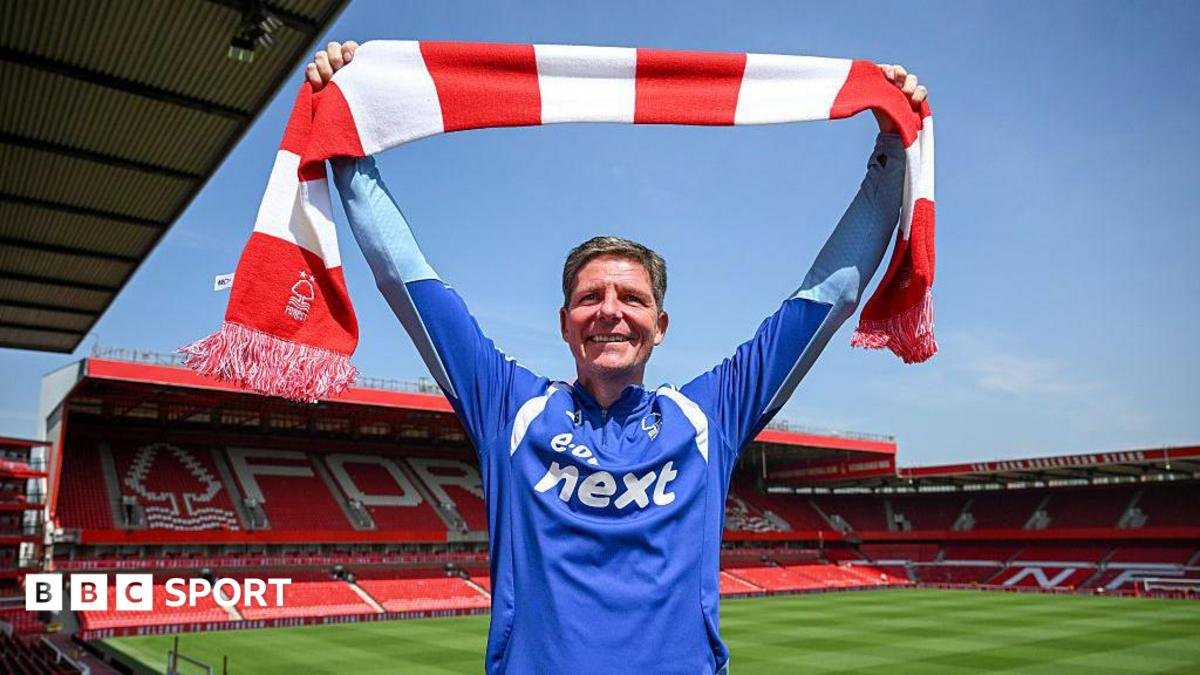
When Oliver Glasner arrived at Selhurst Park in February 2024, Crystal Palace were 15th, having lost 10 of their previous 17 matches under Roy Hodgson.
By season’s end they had climbed to 10th, winning six of their final seven and defeating Liverpool, Manchester United and Aston Villa.
He frequently used a back three, a shape that served him well at Frankfurt, though it’s not something Glasner has pledged to implement straight away at Forest.
“We are not here to be Palace 2,” he said.
“The habits and the patterns are important, how to attack and defend, the spirit you create, to create a shared way of playing and understanding of what we want to do.
“I told the players I don’t know if we will play a back four or back three, we will get the players where they feel comfortable and it’s important they all play in their best positions.
“Get to know the players and find the right system but the patterns and the habits will be the same as at previous clubs.”
Even so, the squad appears well-suited: Ola Aina and Neco Williams look ideal for wing-back roles, with Murillo, Nikola Milenkovic and Morato the senior centre-back options. Zach Abbott is highly regarded but short on top-flight experience.
Nuno experimented with a back three at times, but it wasn’t a system this group used regularly.
At Palace, Glasner inherited a front line of Jean-Philippe Mateta, Eberechi Eze and Michael Olise. This time he has Chris Wood, Igor Jesus, Omari Hutchinson, Dan Nodye and Dilane Bakwa.
Add Morgan Gibbs-White and James McAtee to that, and he has players who fit his approach. Expect Glasner’s Forest to advance up the pitch more quickly.
Last season his Palace team had the Premier League’s fastest attacking speed (2.00 m/s), while Forest ranked 13th (1.80).
Although Forest scored more goals and took more shots than Glasner’s Palace, there is still room for improvement under him.
Both sides had issues converting: Forest tended to create lower-quality chances—only Burnley and Tottenham were worse on average—while Palace fashioned good openings under Glasner but under-finished, ending roughly 17 goals below their xG.
Across four managers, Forest recorded the league’s highest share of backward passes last season at 17.1%, whereas Palace had the lowest, just 14% of their 14,920 passes.
A shift in attacking style seems likely. Forest delivered 628 crosses—the second-most—while Palace attempted only 417, the third-fewest in the division, ahead of only Manchester City and Burnley.
Palace also made far fewer passes in the final third—over 500 fewer than Forest—but Glasner’s philosophy is to be decisive near goal rather than dwell on the ball.
The Eagles created 98 big chances, 29 more than Forest’s 69. Forest still scored more, though—32 to Palace’s 30—with a 43.5% conversion rate compared with Palace’s 32.7%.